

Payment Options & Country Compatibility Review
A terminal on the machine does not mean the merchant can open an account and complete transactions in that country. Onboarding, settlement and refund capability apply only to the stated country, merchant, provider, terminal, interface and customer cycle.
Identify the merchant and country
Start with the country where the machine will operate and the organisation that will receive customer payments. State the desired methods and any existing merchant relationship. The review must connect the machine configuration with that particular operating arrangement.
Record that country and receiving organisation with the machine configuration before the terminal is treated as ready.
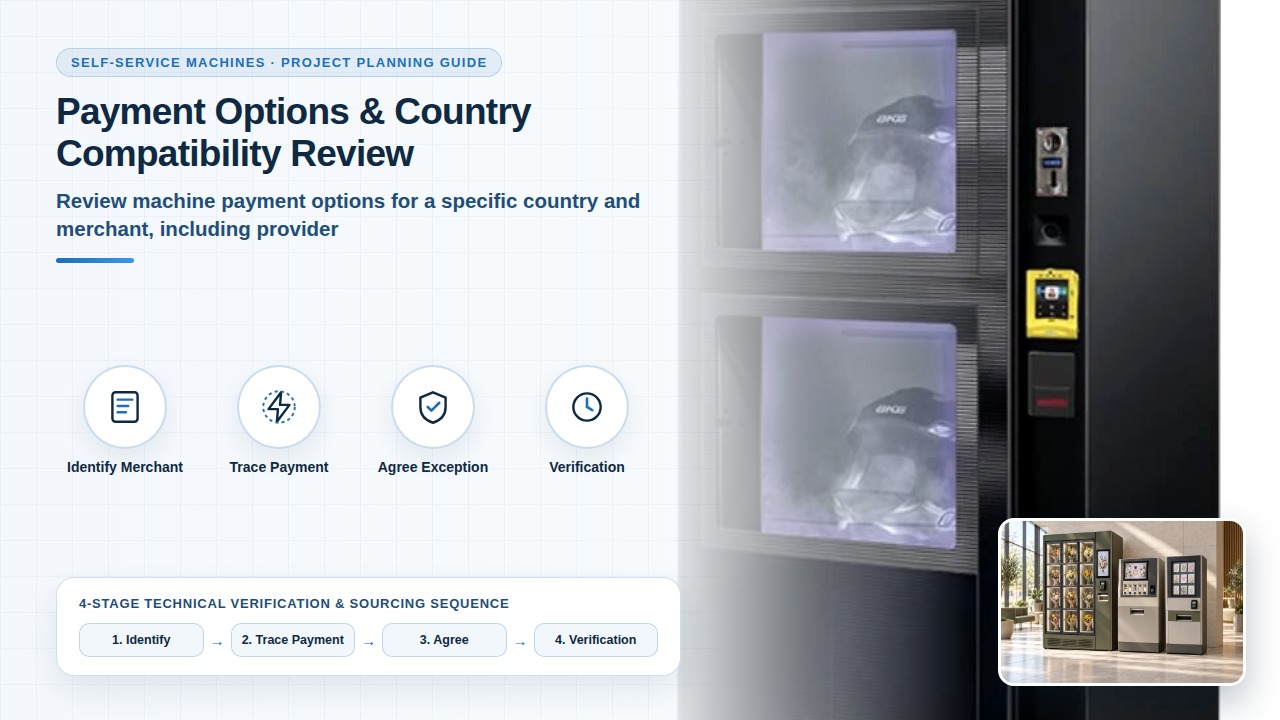
Project review sequence
Trace payment through the operating cycle
Document how the machine receives authorisation, starts the service or releases a product and records completion. Test a successful cycle and the relevant interruptions with the proposed hardware and software configuration. Include a charge with no completed delivery, cancellation, network interruption and the operator's view of the event.
Reconcile the machine's completion record with the payment-provider record before a charge is treated as a completed delivery.
Failed Payment, Failed Service & Refund Workflow — Next step after this review records a charge with no completed delivery: separate the machine event from the payment status, then name who handles the refund.
Payment side and device side
- 1. Authorisation. Payment side: Provider authorisation. Device side: Machine receives authorisation.
- 2. Execution. Payment side: Charge or interruption. Device side: Start service or release product.
- 3. Completion. Payment side: Completed-cycle result. Device side: Records completion.
- 4. Reconciliation. Payment side: Payment-provider record. Device side: Machine record.
Agree exception and account responsibilities
Identify who handles customer requests, checks transaction evidence and performs any required refund or correction. Define access to the merchant account, machine administration and support channels separately. Avoid sharing production account credentials in an enquiry. Ask how equipment replacement, software changes or a change of operator affects payment setup.
Leave production account credentials out of the enquiry, and ask again when the operator, the equipment or the software changes.
Software Access, Data & Service Ownership — Next step when a software change or a change of operator may affect this payment setup: name the software account, the interface and the handover before the previous arrangement is treated as still able to complete transactions.
Use a verification matrix
Record: country and merchant entity; payment provider; terminal model; machine interface; test environment; completed-cycle result; failed-cycle result; settlement confirmation; refund responsibility; unresolved items. Keep the evidence reference and reviewer beside each entry. This matrix is an input to a payment review, not a country-specific approval or a statement that the listed features are available.
Check the full payment cycle against the exact country, account and equipment combination.
Payment Integration Verification Matrix — Input for the country, merchant, provider, terminal and machine interface on this page: record that combination, the failed transaction, the refund and reconciliation before the row is treated as country approval.
Frequently asked questions
If the operator changes, does the payment configuration need to be tested again?
Yes. This review connects the machine configuration with one operating arrangement, and it says to ask how a change of operator affects payment setup, together with equipment replacement and software changes. When the operator changes, discuss access, exports, configuration and equipment operation rather than treating the previous setup as unchanged. Reassess the relevant cases after an account, provider, firmware or interface change. A recorded pass applies only to the recorded case and configuration.
Does a successful payment mean the machine finished the delivery or service?
No. Record authorisation, the start of the service or product release, and completion separately, and include a charge with no completed delivery. A payment success screen alone is not a completed machine transaction. Compare the machine event with the payment-provider status before treating the session as finished.
Which account details should not be sent in an enquiry?
Do not send production account credentials, private credentials, full card details or customer payment information. Keep merchant-account access separate from machine administration and support access. The enquiry uses the country and receiving entity, payment method and provider, terminal and machine interface, test environment, and refund responsibility.