

FLOWERS WITHIN REACH
Flower Vending Machines for Unattended Bouquet Sales
Start with finished bouquets, containers and the proposed locker or delivery format. Cooling and product-care suitability need evidence for that configuration and a refill owner.
For operators, commercial sites and equipment distributors.
Share your machine configuration and operating requirements with our team.
Explore the details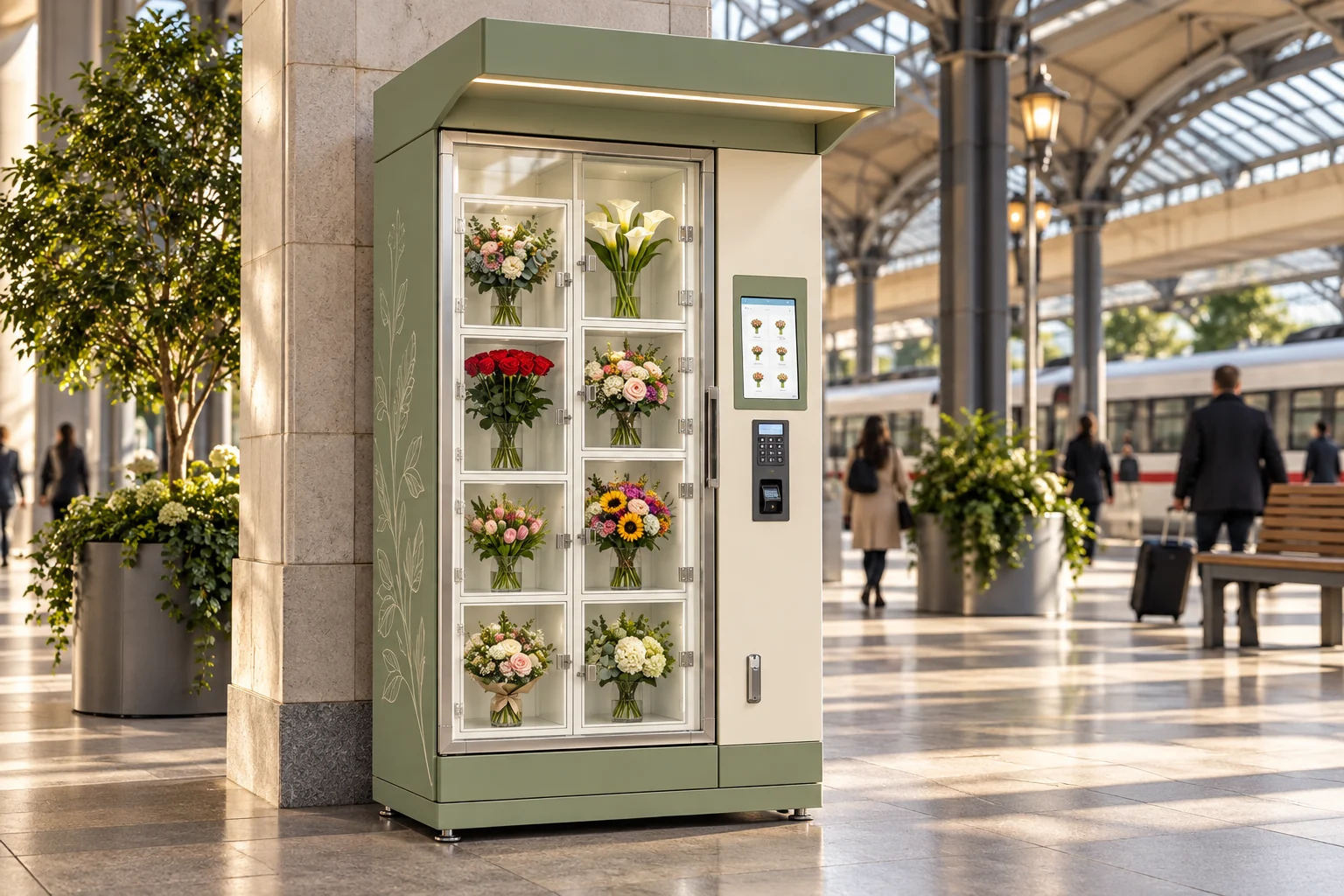
- Bouquet-first display
- Compartment fit
- Planned stock rotation
POSSIBLE SETTINGS
Florist storefronts
Hospital visitor areas
Station concourses
FROM IDEA TO CONFIGURATION
Let the bouquets do the talking.
- Measure your wrapped bouquets
- Choose the display arrangement
- Plan product care and replenishment
01
Bouquet Lockers vs Other Dispensing Formats
Start with a locker cabinet that presents a bouquet behind an individual door. Confirm how a customer selects and pays for that compartment, how the door unlocks and how the bouquet is removed. A drop-style dispenser is a different route and needs a separate product-handling test.
Project review sequence
02
Match Compartments to Real Bouquets
Measure the finished bouquet rather than the stems alone. Record overall height, widest diameter, wrapping, handles, a water container if used and the clearance needed to grip and remove it. Include both the typical bouquet and the largest seasonal format. Use those measurements to build a bouquet-to-compartment fit list. Check that wrapping does not obstruct the lock, seal or door and that restocking can be performed without damaging adjacent bouquets.
Bouquet measurement and removal clearance
03
Refrigeration & Product Care Requirements
Send our engineering team the product-care requirements specified by your florist or product team. Ask which cabinet zones are controlled, where temperature is measured, how condensation is managed and what happens during a power interruption. Flower selection, wrapping, water arrangements and replenishment practice also belong in the trial record. We agree the cooling configuration and product-care conditions for the selected assortment and installation site.
04
Locations, Restocking & Unsold Stock
Describe whether the site extends an existing florist, serves a shopping location or operates as a separate replenishment route. Identify who selects bouquets, visits the machine, removes unsold stock and responds when a compartment cannot be opened. Record replenishment access, permitted visiting times and the process for checking presentation and product condition. An unattended sales interface still requires a named operator and a practical plan for stock rotation and customer assistance.
Flower Vending Restocking & Stock Rotation — Plan flower vending visits, bouquet rotation, cleaning and stock records using the tested assortment and observations from your location.
05
Configuration, Payment & Quote Scope
A configuration review should identify the number and dimensions of compartments, cabinet format, any verified cooling arrangement, payment hardware and the required display language. Separate equipment, packaging, freight, installation and ongoing support in the requested quotation. Do not assume that the presence of a card reader establishes local settlement or refunds. Final equipment pricing and availability depend on the reviewed model and scope.
Flower Vending Machine Cost & Quote Factors — Use this when the quotation must separate bouquet fit, cabinet options, installation, replenishment and unsold-stock costs.
06
Request a Flower Vending Site Review
Start the enquiry with the country, site type, expected quantity, purchasing window and the person responsible for replenishment. If the rollout begins with a trial, explain the trial location and the decision you want it to inform. Discuss bouquet images, packaging dimensions and any physical samples needed to evaluate the proposed configuration. These inputs support a fit review rather than a stock reservation.
Frequently asked questions
How do I check fit for a bouquet that includes a water container?
Measure the finished bouquet rather than the stems alone. Record overall height, widest diameter, wrapping, handles, the water container when one is used, and the clearance needed to grip and remove it. Include the typical bouquet and the largest seasonal format, and check that the wrapping does not obstruct the lock, seal or door. Ask for the internal dimension drawing and a removal demonstration. The restocking record keeps wrapping, container use and the dimensions that affect loading and collection with that assortment version, and a new format is reviewed before it is treated as an earlier sample. The cost comparison records bouquet dimensions, wrapping, containers and the presentation at collection, and keeps that tested format with the equipment price.
Who handles a compartment door that will not open?
Name the person who visits the machine, removes unsold stock and responds when a compartment cannot be opened. An unattended sales interface still needs that named operator, and the payment arrangements for the country of operation include failed payment and door-release outcomes. Inspections and removals are recorded by the local operator. A routine visit covers the documented loading and cleaning tasks; service support covers what that visit cannot. Sell-through, shelf life and the financial result stay in the operator’s commercial review.
Does temperature control guarantee a number of freshness days?
Cooling and product-care suitability need evidence for the selected configuration. Send the florist or product-team requirements, and ask which cabinet zones are controlled, where temperature is measured, how condensation is managed and what happens during a power interruption. Flower selection, wrapping, water arrangements and replenishment practice belong in that trial record. Neither a cabinet feature nor a quoted temperature-control option establishes a fixed freshness period, a level of demand or the proportion of stock that will sell. Temperature control is marked as included or separately priced for the proposed model, and shelf life stays in the operator’s commercial review of the visit record.