

Custom Vending Machine Configuration & Manufacturing
Write the change relative to a standard configuration first, then define sample, cabinet and software delivery separately. Treating a modified drawing or an existing screen as a verified function causes acceptance-scope omissions.
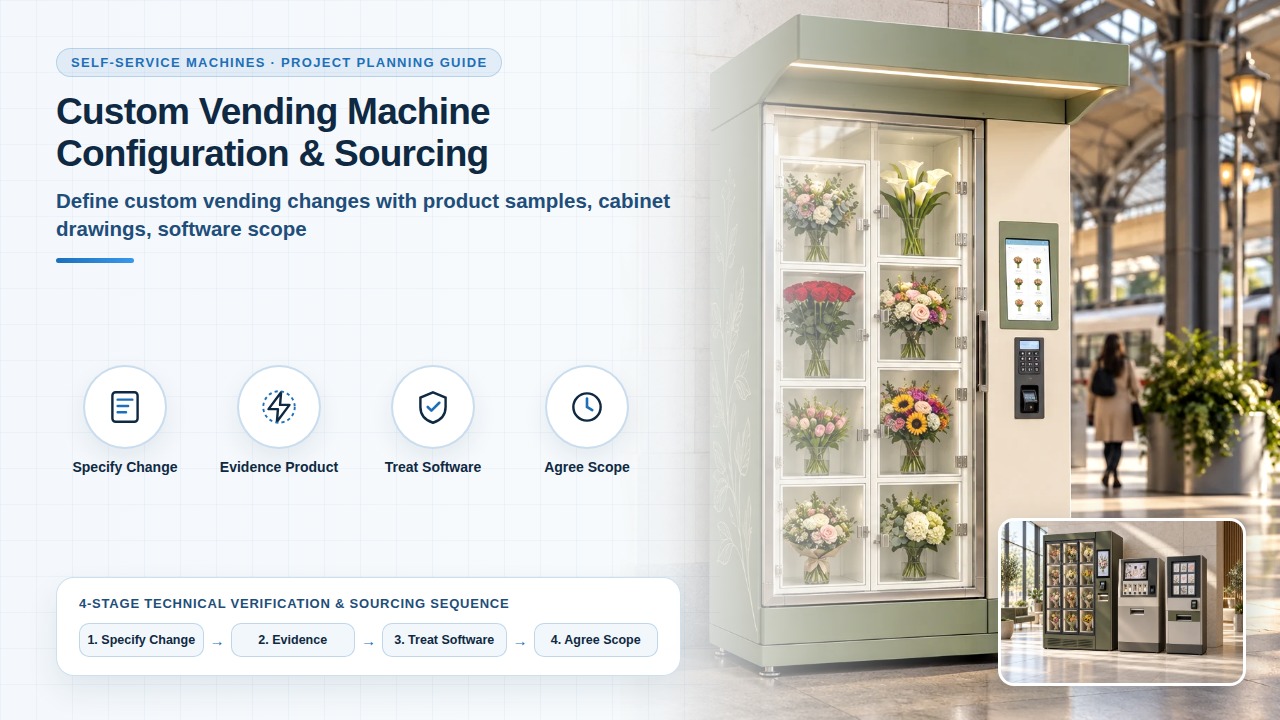
Specify the change to a standard configuration
Begin with the operating task and the difference between your requirement and the proposed standard machine. Group requested changes into product handling, cabinet layout, customer interface, payment, software and site installation. Custom vending is a project scope across equipment categories, not an additional product category. A flower cabinet, employee consumables dispenser and phone-case project need different samples and acceptance checks even when each requires custom work.
Flower Vending Machines for Unattended Bouquet Sales — Use this when a flower cabinet is one of the custom routes, so bouquet size, refrigeration, location and restocking stay in that category’s own review.
Schematic: three acceptance lines
Prepare evidence for product and cabinet changes
Provide the dimensions, weight and packaging of the sale units to be handled. Describe loading, customer collection and replenishment access. Ask whether the proposed change can be demonstrated using representative samples and identify any limits on the tested assortment. For cabinet changes, request drawings tied to the actual proposal. Match the approved drawing to the finished unit and record the operating checks in its acceptance report.
Treat software and payment as defined deliverables
Describe the customer sequence, operator controls and information that must move between systems. Name the account owner, required interface, test environment and party responsible for implementation. Distinguish a payment terminal option from an integration with an existing membership or business system. Ask the proposal to identify supported functions, development work, licence conditions and unresolved dependencies. Interface access for the particular workflow is confirmed on the selected screen or card reader.
Agree scope changes and acceptance
Compare proposals using a versioned requirement list. For each change, record whether it is essential for operation or a visual preference, the input, the owner, the evidence, the included work, the cost basis and the effect on the intended schedule. Use the four scope levels published for custom self-service projects: a standard option, a physical change, system integration, or new development. The combo vending page assesses a combined machine from the finished sale units, loading positions and storage needs, and includes product-fit checks and unsuccessful-vend handling in factory acceptance, rather than a universal channel. A discussion begins a feasibility review; it does not accept development work or confirm delivery. Final drawings, operating tests, exclusions and commercial terms need agreement before the proposed custom scope is treated as settled. Supply and adaptation stay inside that written list until a response names what is confirmed, what still needs a sample or drawing check, and what is outside the proposed scope. This record prepares the purchase. It is not a completed measured test or a service commitment.
Standard Options & Custom Self-Service Projects — Use this to place each vending change in the published four-level scope: standard option, physical change, system integration or new development.
Combo Snack and Drink Vending Machines — Use this when the route is a snack-and-drink combination, so finished sale units, loading, storage, product-fit checks and unsuccessful-vend handling stay in that published scope.
Frequently asked questions
Is custom vending a separate equipment category?
No. This page treats custom vending as a project scope across equipment categories, not as an additional product category. A flower cabinet, an employee-consumables dispenser and a phone-case project each need their own samples and acceptance checks. The custom self-service page separates retail vending, self-service cleaning and commercial dispensing, and classifies a requirement as a standard option, a physical change, system integration or new development.
Does a modified drawing equal acceptance of the finished machine?
No. A cabinet change needs a drawing tied to the actual proposal. Acceptance is matching that approved drawing to the finished unit and recording the operating checks in the acceptance report. Treating a modified drawing or an existing screen as a verified function causes acceptance-scope omissions. The custom self-service page uses the same boundary for a physical change: the drawing still needs a review of operation and service access, and an existing screen does not set the development scope.
Can one custom result be copied directly?
Not from the record on this page alone. Identify whether the result is a one-off configuration or something that can be repeated for later units. A flower cabinet, an employee-consumables dispenser and a phone-case project need different samples even when each is custom work. The custom self-service page keeps a payment-terminal option, a cabinet drawing with the sale-unit sample, and a membership or business-system interface in different classes. Copying one accepted unit stays an open item until that class, evidence and version are recorded. The record prepares the purchase. It is not a completed measured test or a service commitment.