

Live Bait Vending Machines: Aeration, Dissolved Oxygen and Water Temperature
Troubleshoot live bait vending machines using dissolved oxygen and water temperature readings, airflow checks, chiller settings and a tested outage response.
By SelfServiceMachines
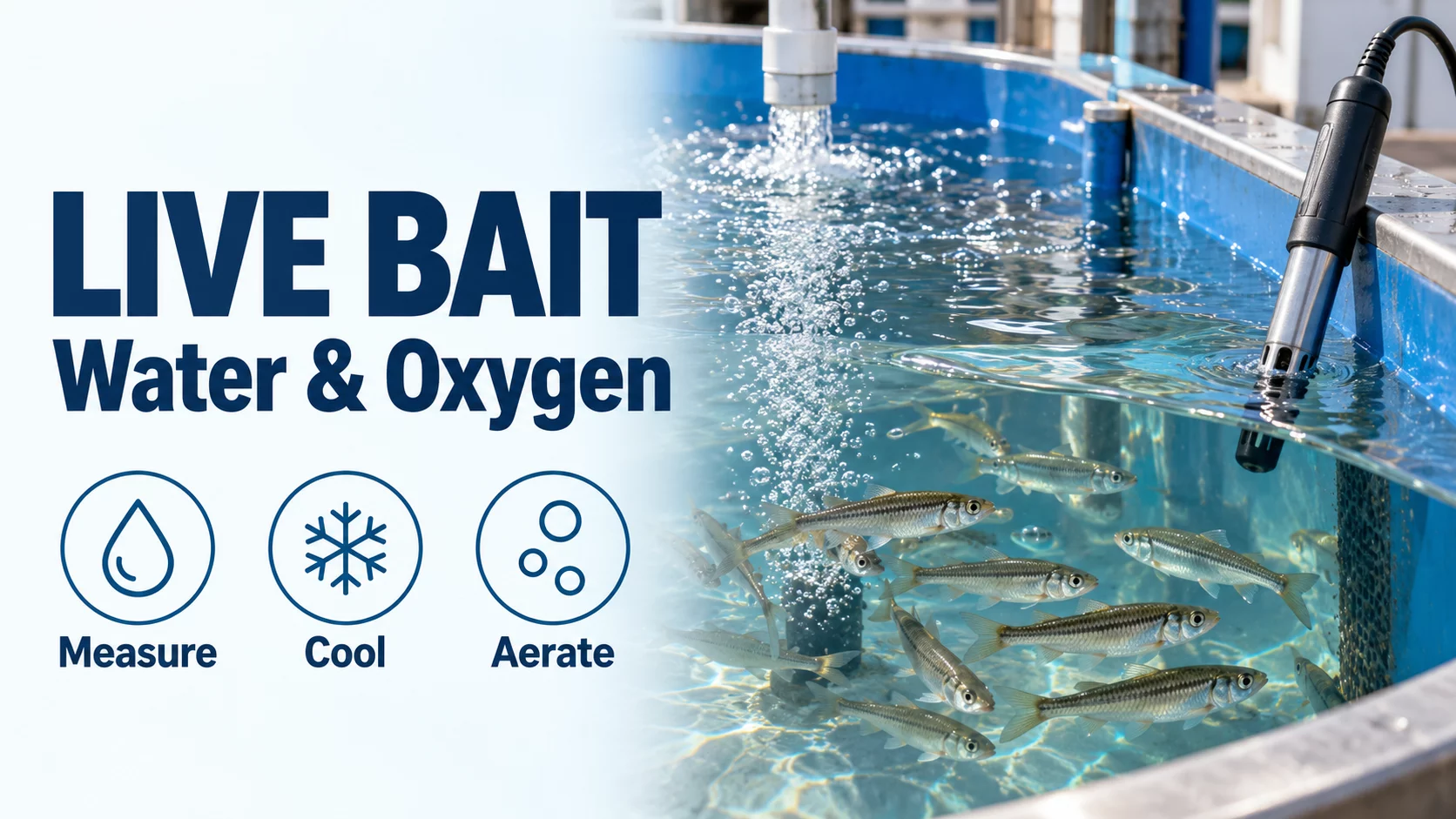
Which water needs aeration?
Start at the bait itself and trace its water supply. The checks below apply to aquatic baitfish in a shared vending tank or in the holding tanks used to replenish a vending machine. Record the species, freshwater or saltwater, water volume, depth and maximum fish load before assessing the equipment.
For minnows sold in individual closed cups, validate the filled package and its holding period separately. Air delivered to a nearby tank cannot replenish oxygen inside a sealed cup. Package fill, gas exchange, closure retention and leakage through dispensing all belong in that trial. Worm and cricket storage needs a different husbandry plan.
Packaged versus live bait vending — Use the storage-format comparison when choosing how bait will be held and dispensed.
What should the oxygen and temperature readings tell you?
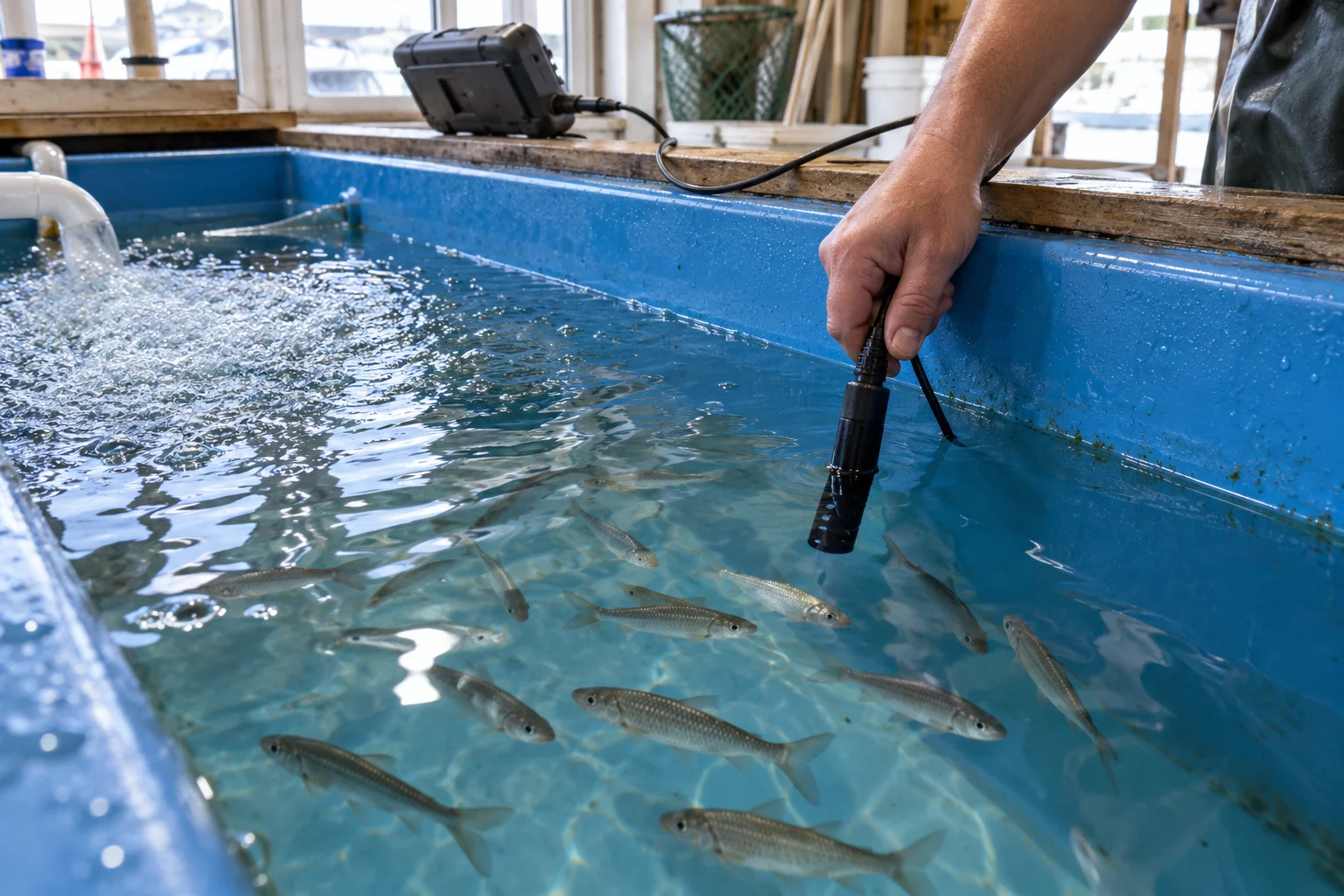
Measure dissolved oxygen (DO) in the stocked holding water and record water temperature at the same time. USGS explains that warmer water holds less oxygen than colder water. A thermostat setting or the sound of a running pump cannot establish the condition of the water around the fish.
UF/IFAS Circular 919, Stress—Its Role in Fish Disease, recommends at least 5 mg/L DO as part of good cultured-fish water quality, together with pH and temperature suited to the species. Set the holding system's normal, warning and intervention levels with the bait supplier or aquaculture specialist for the species, fish load and holding duration. The warning point must allow time for the operator to act.
Use the meter's calibration and sampling procedure. Record DO in mg/L; keep percent saturation in a separate field if displayed. YSI's Dissolved Oxygen Measurement in Water guide explains the influence of temperature, salinity and barometric pressure on these readings. Check the instrument's compensation settings and sensor condition before interpreting an unexpected change.
Keep a time-stamped record at consistent sampling locations, including after replenishment and during the warmest operating conditions. Compare a suspect fixed sensor with a maintained portable instrument. If the fish are distressed, begin the agreed stock-protection response while validating the reading.
- USGS — Dissolved Oxygen and Water
- UF/IFAS — Stress—Its Role in Fish Disease (Circular 919)
- YSI — Dissolved Oxygen Measurement in Water
Why can water warm up while the chiller is running?
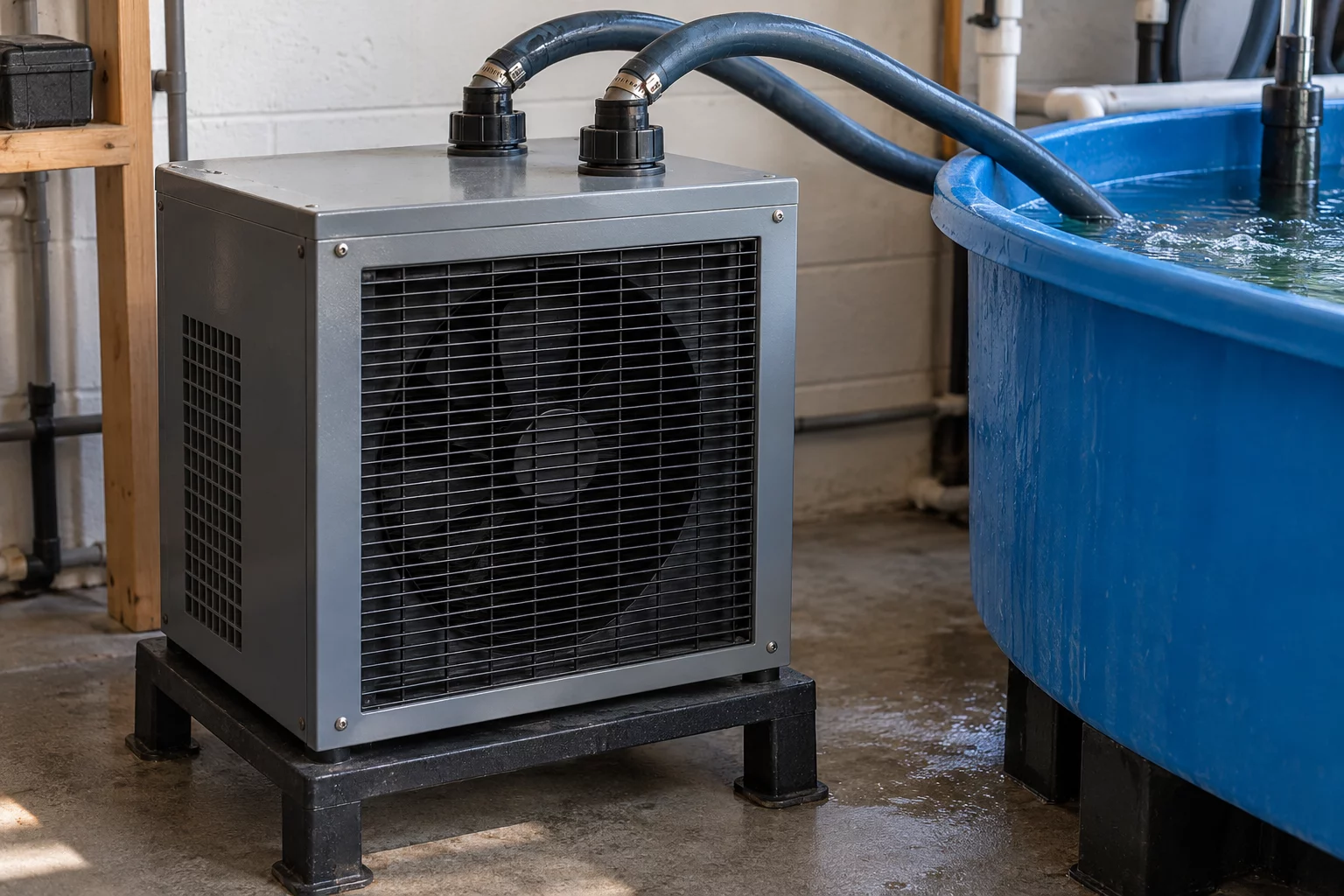
Check actual tank temperature, water circulation and the chiller's ability to reject heat before lowering the thermostat. A running compressor can coexist with restricted water flow, a dirty condenser or an installation that recirculates hot exhaust air. Follow the selected chiller's clearance, flow and cleaning instructions.
The setpoint is the controller's target; the switching differential is the gap between its switching conditions. In Aqua Logic's DC24S instruction manual, the factory differential is 1°F. Its cooling parameters call for cooling at setpoint plus differential and switch off as water returns to the setpoint region. That setting controls cycling; tank temperature must still be measured across the operating cycle.
Use the species' holding requirements to choose the operating band. Hugh Thomforde's 2001 retail guide, Keeping Baitfish Alive and Healthy in Holding Tanks, recommends water below about 65°F (18°C) in its retail-holding context and gradual acclimation of incoming fish. Choose the final band for your bait species and season, and follow an acclimation procedure when delivery water and tank water differ.
For a chiller capacity review, collect the inputs in Aqua Logic's System Questionnaire Form, revision 8-14: fluid type, total circulating water volume, incoming water temperature and flow, ambient extremes, desired water temperature, pull-down time, tank construction and insulation, and added heat loads. Include pumps and sunlight. Send those conditions with the selected chiller's performance data so capacity can be checked at the actual operating point.
- Hugh Thomforde — Keeping Baitfish Alive and Healthy in Holding Tanks (2001), pp. 141–142
- Aqua Logic — DC24S Instruction Manual, pp. 2–3; System Questionnaire Form, revision 8-14
Outdoor bait vending site checklist — Review exposure, ventilation, power access and service responsibility at the installation site.
How do you trace weak or missing air delivery?
Follow the air path from the power supply to the diffuser, then verify the DO response in the stocked water. Bait vending aeration depends on delivered air at the installed water depth and on distribution through the holding circuit. Pump noise is only one observation.
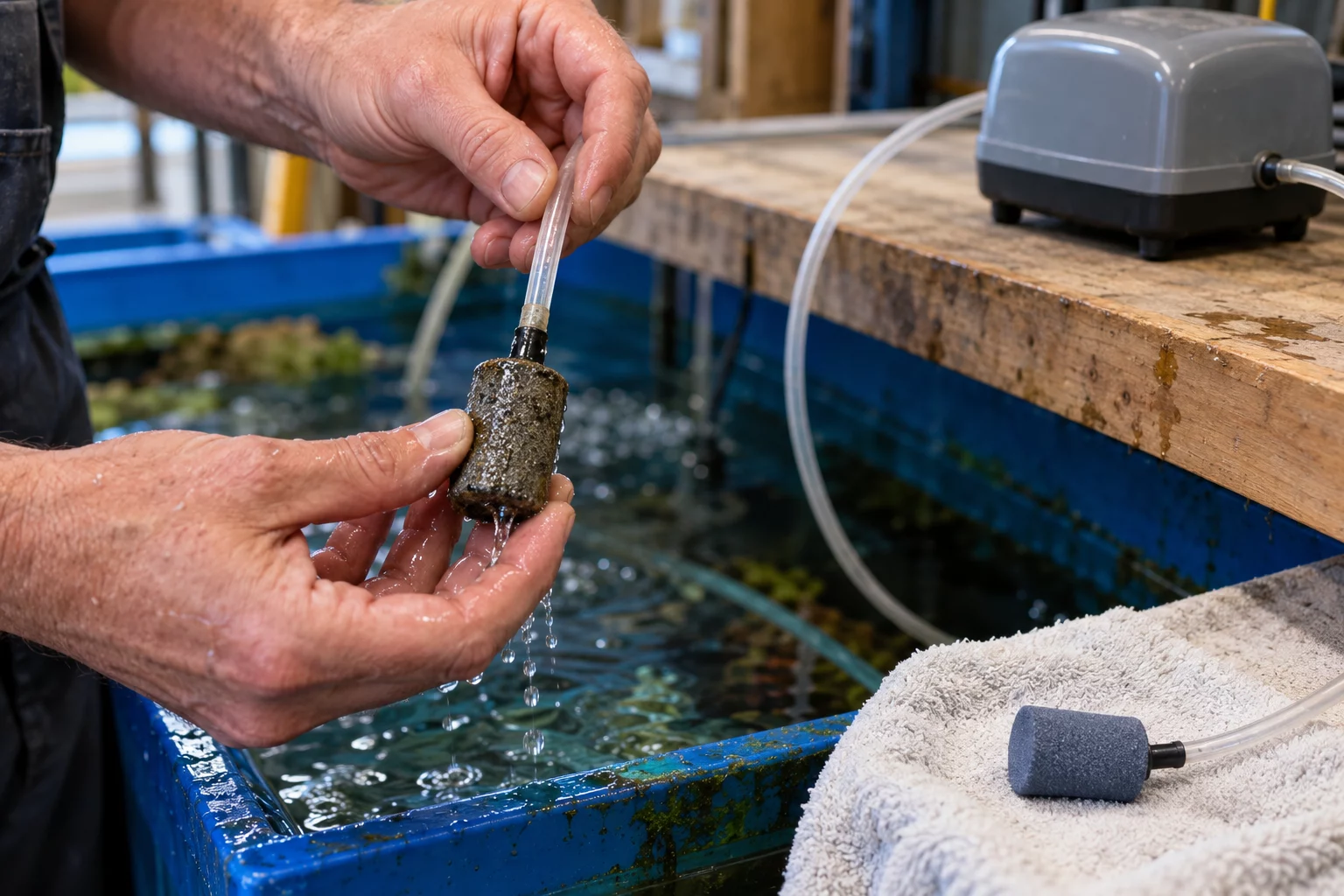
Check power and operating mode first. Then inspect the air inlet, loose connections, hardened or split tubing, tight bends, non-return valve orientation and diffuser fouling. Aquatlantis's Tecatlantis Air Pump manual identifies back-siphoning, tubing deterioration and blocked diffusers as maintenance concerns. Use the installed pump's instructions for placement and non-return protection.
Before disconnecting wet components or carrying out maintenance, follow the equipment's electrical isolation procedure and arrange alternate holding or aeration for the fish. Keep the pump dry and secure. Clean serviceable parts as directed; replace damaged tubing or a diffuser whose flow cannot be restored. Sealed pump internals and electrical faults belong with the authorized service provider.
After reassembly, check for leaks and confirm airflow at operating depth. Compare DO at the established sampling locations under the current load. Keep compatible tubing, non-return valves and diffusers identified by their connections and ratings, alongside the pump model and service contact.
- Aquatlantis — Tecatlantis Air Pump manual, Installation and Operation / Maintenance
What must keep working during a power outage?
Verify backup aeration, temperature control and the alert path as separate functions. Dymax describes automatic battery changeover for its AP1000 air-pump component. For a vending installation, check the selected pump, battery, charger and transfer arrangement together at the actual water depth.
A mains-failure switch responds to loss of electricity. A split air hose or failed aerator can occur while mains power remains healthy, so include a separate air-delivery or DO fault scenario in the acceptance plan. A remote warning also depends on power reaching the sensor, controller and communications equipment.
Agree the required service response time and stock-transfer plan before commissioning. Start with unloaded checks, then use a supervised operating trial with predetermined stop limits and a qualified operator present. Log the transfer delay, delivered air, DO, water temperature, battery condition and notification receipt. Stop the trial before the approved intervention limits are reached.
During an outage, follow the recorded DO and temperature trend and call the designated responder. Move stock to prepared holding arrangements when the plan requires it. After mains returns, verify air delivery, battery recharge and cooling recovery, observing the installed chiller's compressor restart instructions. Battery runtime and acceptable bait-holding time must both cover the response plan.
- Dymax — AP1000 product description, automatic battery operation
What should you send before discussing equipment or repairs?
Send the readings and the physical configuration together. A useful fault report links each DO and temperature observation to the time, fish load, ambient conditions and equipment state. Include what changed after an intervention, such as replacing a blocked diffuser or restoring circulation.
For a new installation, use the same information to define holding capacity, cooling duty, backup coverage and the operator's response plan. Photos of the water circuit, component labels and available service access help connect those requirements to the proposed configuration.
Bait vending machines and project configuration — Bring the water-holding requirements into the machine and sale-unit assessment.