

Ready-Made Phone Case Vending vs Custom Printing
Assess stocked-case release separately from the blank, artwork and processing sequence for custom printing. The two routes need different samples and operating evidence.
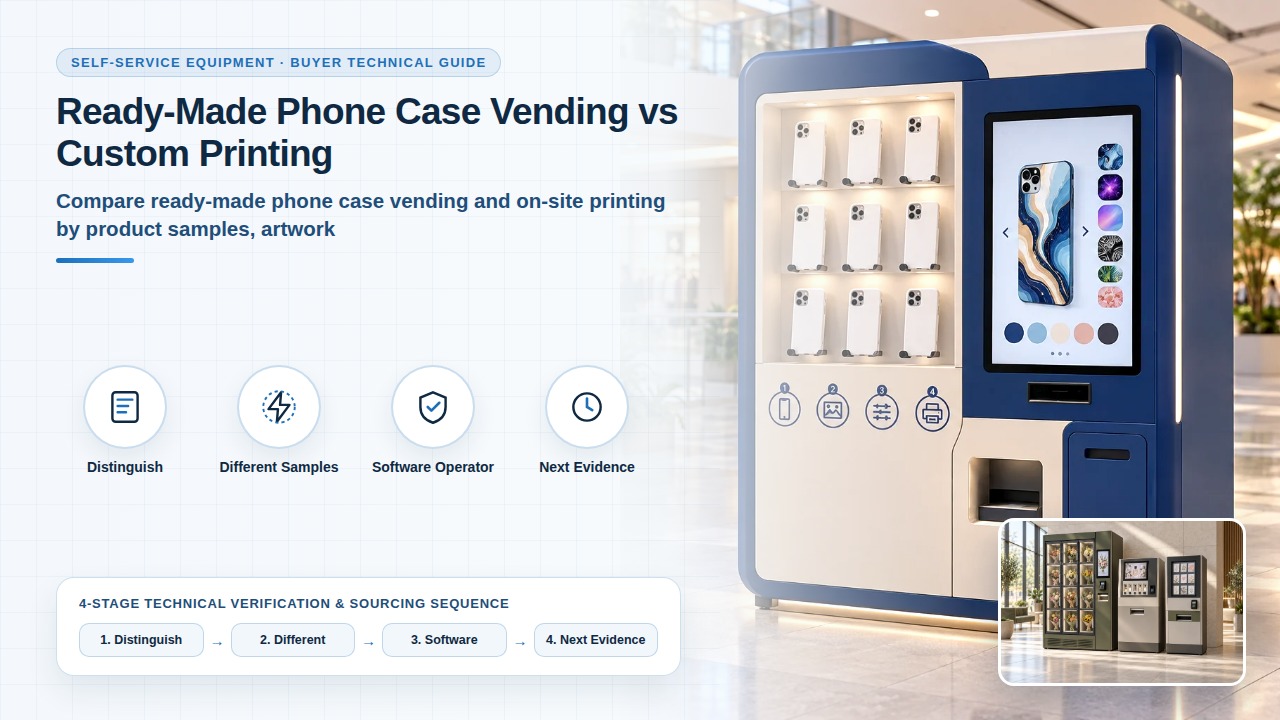
Distinguish a stocked product from a production job
For ready-made case vending, the customer selects a packaged product already held in the machine. The review centres on the assortment, phone-model identification, packaging fit, selection and collection. For on-site printing, describe the proposed sequence from selecting a compatible blank through artwork, processing and collection. Each step needs evidence for the actual configuration.
Phone Case Vending and Custom Printing Project Options — Use this page to decide whether the project is stocked-case release or a separate printing configuration.
Stocked-case release
Print-to-order sequence
Prepare different samples for each route
For stocked products, provide representative final sale units with dimensions, weight and packaging. Test the loading and release arrangement with the intended assortment. Record any product format that has not been assessed. For printing, identify the proposed case blanks, phone models, artwork workflow and output requirements.
Phone Case Machine Blank & Model Compatibility — Use this page to decide whether the blank, fixture, phone model and print software are one demonstrated combination.
Review software and operator responsibilities
A printing discussion should identify artwork acceptance, preview, customer confirmation, interrupted jobs and the information retained or deleted. Use non-confidential test artwork and clarify the permissions associated with any designs. Both routes need local replenishment, customer help and maintenance arrangements, but the tasks are not identical. Ask our engineering team to document the work included in the actual configuration and the activities requiring an operator or technician.
Choose the next evidence to request
State whether your project is stocked vending, printing or an open comparison. Define the trial outcome, site, country, quantity plan and sample availability. Equipment capability is confirmed in the model-specific verification for the selected stocked-vending or printing route.
Frequently asked questions
Can an existing phone-case supply chain prove equipment capability?
Retail or distribution experience and the case samples identify the sale units for a stocked route. Equipment capability is confirmed in the model-specific verification for the selected stocked-vending or printing route. Ready-made review covers the assortment, phone-model identification, packaging fit, selection and collection. On-site printing capability is confirmed in the demonstration for that printing route, when the offered blank, fixture, print process and software version are demonstrated together. The supported-model list is the verified list of blanks, inventory and software in the proposed configuration.
Can a picture of a printed case replace a full-process test?
Do not treat an image of a printed case as proof of blank compatibility, processing quality or a complete unattended customer workflow. The printing sequence runs from a compatible blank through artwork, processing and collection, including upload, preview, confirmation, interruption and image handling. The offered blank, fixture, print process and software version are demonstrated together. One successful sample stays with the case materials, finishes, phone models and consumable combinations that were demonstrated.
Does an inquiry accept custom development?
The equipment discussion accepts neither development work nor a delivery date. Documented standard options stay separate from cabinet changes, software integration and new development. A request for another case type or a different artwork workflow may affect more than the outer cabinet. Send the country, site, route, quantity, sample availability, artwork workflow and pilot goal so those records can continue the scope and configuration discussion. The printing route remains subject to model-specific verification and a separate scope.