

Remote Monitoring: Functions to Verify
An older retained reading is not the current online status. Verify the timestamp, connection-loss display and response owner for each monitoring event. Current online status is the timestamped connection state recorded for that event.
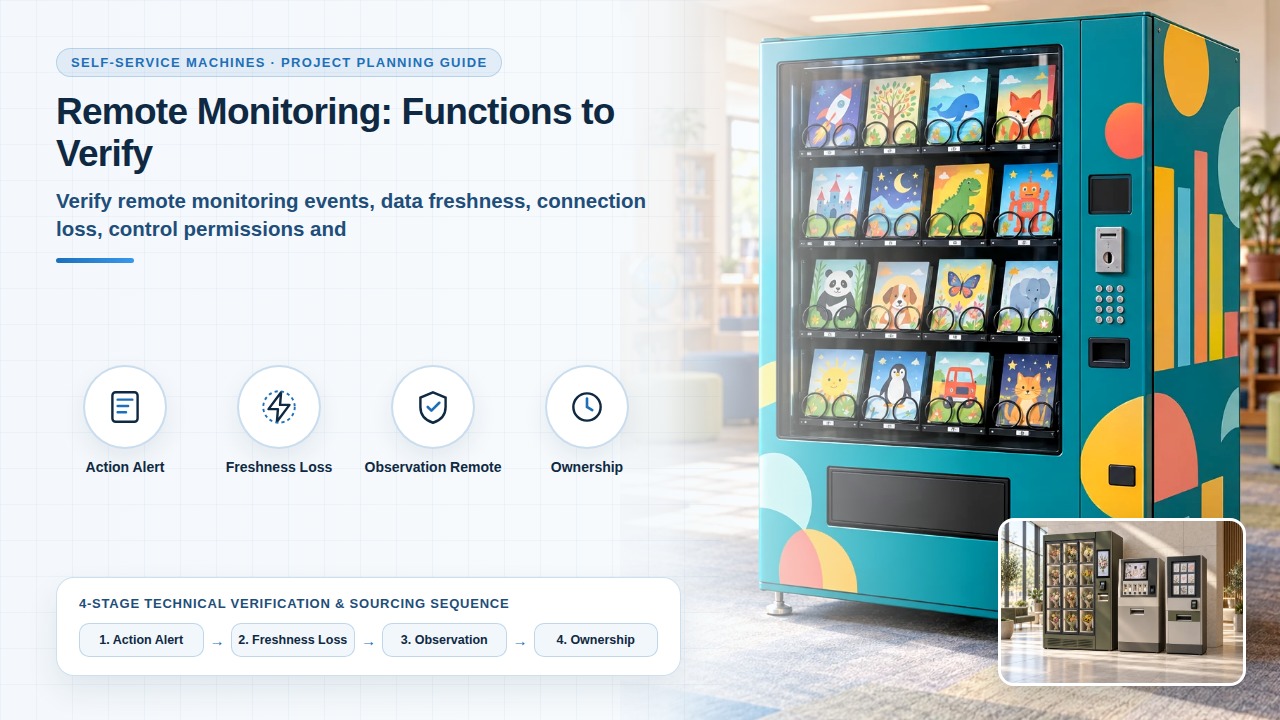
Start with the action an alert should support
Identify what the local team needs to know: a product running low, a machine unavailable, a consumable requiring replacement or a transaction needing investigation. For each event, name the person who should respond and the observation that would justify taking action.
Failed Payment, Failed Service & Refund Workflow — Next step when the event is a transaction needing investigation: separate the machine event from the payment status before a restart or a refund.
Monitoring event sequence
Check freshness and loss of connectivity
Request a demonstration of timestamps, the last successful connection and the difference between a current reading and an older retained value. Agree how the operator recognises missing or stale information. Include the proposed site network and account arrangements in the review. Observe whether events are duplicated, omitted or presented out of order. Do not assume that a dashboard remaining visible means the machine is currently connected or able to complete a customer session.
Smart Vending Features & Integration Review — Input for the freshness check: whether a displayed value is measured, estimated or an older retained value after connection loss.
Separate observation from remote control
List the actions the system allows an operator to perform remotely and the permissions required for each. Distinguish viewing a condition, acknowledging an alert, changing a setting and restarting a process. Ask for the model-specific restrictions and local checks that apply. A remote action should not be treated as a substitute for inspecting a fault or following the equipment's documented safe procedure.
Define ownership of follow-up
Specify alert recipients, coverage hours, escalation and the records used to close an incident. For multiple sites, show how an operator identifies the affected unit and location. The review should produce an included-function list, test observations and unresolved dependencies. Remote recovery, connectivity and the monitoring service are listed for each machine in the included-function record.
Software Access, Data & Service Ownership — Next step for the response account: name who can grant, change or remove access to view machine events or issue a remote command.
Frequently asked questions
How is an old inventory figure recognised after the connection drops?
Compare the displayed figure with its timestamp, the last successful connection and the older value retained during the interruption. A figure inferred from sales is not the same as a physically measured quantity, and a dashboard that stays visible does not mean the machine is currently connected. Current online status is the timestamped connection state recorded for that event. Stock checks the monitoring configuration does not cover stay with the named local response owner.
Who can restart a machine remotely?
Restarting a process is a separate permission from viewing a condition, acknowledging an alert or changing a setting. The review names the account allowed to issue that command, the model-specific restrictions and the local checks, and the system records who issued the command and what result was observed. A remote restart does not replace a local inspection or the equipment's documented safe procedure, and it does not show that the fault is resolved or that the machine is ready to resume.
How do you check missed or duplicate alerts after reconnection?
In the demonstration, note whether events are duplicated, omitted or presented out of order, and compare each one with its timestamp and the last successful connection. Ask what was retained during the interruption and how it appears after reconnection. An older retained value is not the current online status. A machine alert and a payment-provider status can describe different parts of the same session, so the close record should show the decision once rather than applying the same correction twice.