

Smart Vending Features & Integration Review
Replace the smart label with refill, fault, reconciliation and permission tasks supported by dated demonstrations. A dashboard value may be measured, estimated or stale after connection loss.
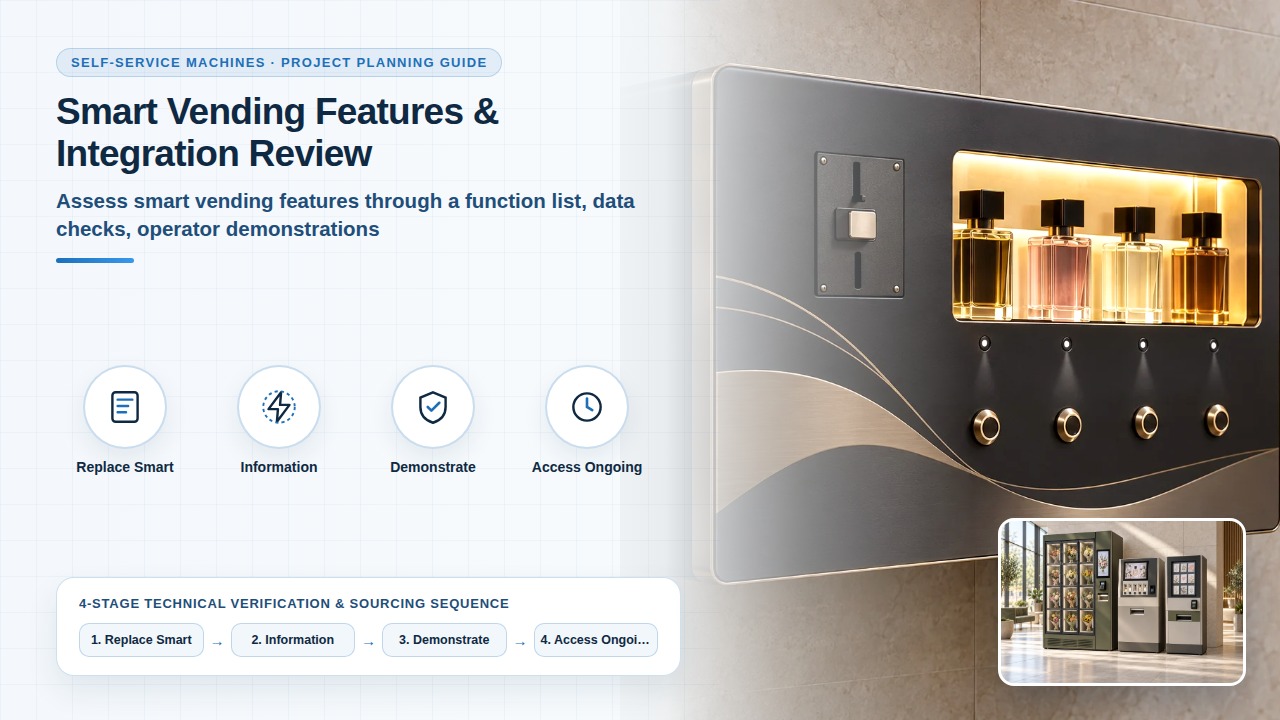
Replace the smart label with a function list
Describe the decisions an operator needs to make and the information needed for each decision. Examples to investigate include replenishment planning, fault response, sales reconciliation and access control. Do not use the word smart as evidence of a feature. A connected display, a payment device and a remote management service may have different responsibilities. Require a description of each included function, its data source and the conditions under which it works.
Remote Monitoring: Functions to Verify — Verify remote monitoring events, data freshness, connection loss, control permissions and the local team responsible for responding to alerts.
Software Access, Data & Service Ownership — Clarify machine software accounts, data exports, interfaces, subscriptions, updates and handover rights before agreeing a service scope.
PPE Vending Integration Requirements — Scope PPE vending integration with identity and inventory systems, including data exchanges, connection loss, access and acceptance tests.
Project review sequence
Check how information reaches the operator
For each displayed value, ask what the system measures, estimates or receives from another service. Record its update frequency, timestamp and behaviour when connectivity is interrupted. A stock figure inferred from sales should be assessed differently from a physically measured quantity. A payment report should be reconciled with completed deliveries and exceptions. The review should identify what an operator can reasonably conclude from the information and what needs a separate check.
Machine event to operating decision
Demonstrate routine work and exceptions
Walk through account setup, access permissions, replenishment, a successful customer session and a relevant failed session. Ask our engineering team to show the operator's view of an interruption and the actions available to resolve it. Test the agreed configuration rather than relying on a dashboard from another product. Include lost connectivity, unavailable consumables and a change of operator where relevant. Do not describe remote recovery, forecasting or AI capabilities as included unless the actual scope and evidence support that statement.
Include access and ongoing service in the comparison
Ask who owns the account, what subscriptions or connectivity services are required and what happens when a licence or service ends. Define exports, support, updates and responsibilities for changes to connected systems. Separate optional services from the machine purchase. Smart vending combines equipment with software and operating workflows across equipment categories. Verify the data source and working conditions for each management function on the selected category; the word smart does not replace that evidence.
Frequently asked questions
Is a stock figure measured, or estimated from sales?
Record whether the stock figure is physically measured or inferred from sales, together with its update frequency and timestamp. When connectivity is interrupted, record how that figure behaves and compare it with the machine during a demonstration. The remote-monitoring review treats an older retained reading as different from the current online status and uses the timestamp and the last successful connection. A dashboard that remains visible is a separate observation from a current connection.
After the subscription ends, which functions should be checked?
Check who owns the account, which subscription or connectivity service each function requires, and what happens to exports, support, updates and changes to connected systems when the licence or service ends. The software-ownership review lists the functions that depend on an active subscription, how a configuration or compatibility change is communicated, and the handover for access, exports, configuration and equipment operation when the service ends or the operator changes provider.
Does a network connection mean remote recovery is supported?
A connected display, a payment device and a remote management service can have different responsibilities. Include remote recovery only when the proposed scope and a dated demonstration support it. The remote-monitoring review separates viewing a condition, acknowledging an alert, changing a setting and restarting a process. A remote action is checked with a local inspection and the equipment's documented safe procedure.