

Automatic Ice Cream Vending Machine: Power, Condenser Clearance and Heat
Separate the sale of pre-packaged frozen products from making soft-serve ice cream at the machine when planning site power and ventilation. Never use an under-size power cord on an automatic ice cream vending machine, because low voltage and overload affect machine performance or cause damage.
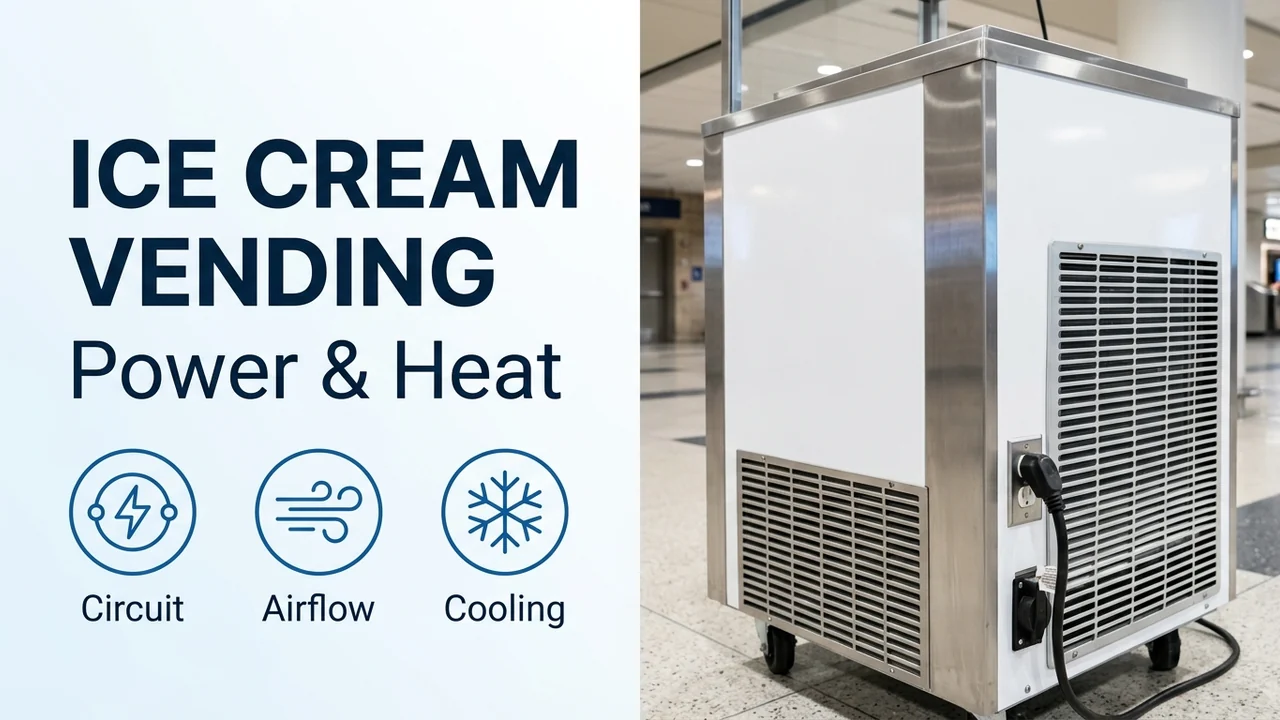
By SelfServiceMachines
Electrical Architecture by Machine Type: Pre-Packaged Frozen Novelty vs Fresh Soft-Serve
Separate the sale of pre-packaged frozen products from making soft-serve ice cream at the machine. On-site production requires a different review of ingredients, preparation, cleaning, and local operation, and is not established by a successful frozen-package vending demonstration. Robotic handling, heat treatment, and other processing functions stay outside the proposal unless the documented model scope includes them.
Under U.S. Department of Energy regulations in 10 CFR 431.62, an ice-cream freezer is defined as a commercial freezer that is designed to operate at or below -5 °F (-21 °C) and that the manufacturer designs, markets, or intends for the storing, displaying, or dispensing of ice cream. Under the amended definition in 10 CFR 431.62, an ice-cream freezer is a commercial freezer capable of an operating temperature at or below -13.0 °F. Under 10 CFR 431.66, self-contained Vertical Closed Transparent (VCT.SC.I) commercial ice-cream freezers have a maximum daily energy consumption standard of 0.62 × TDA + 3.29 kWh/day. Under 10 CFR 431.66, self-contained Vertical Closed Solid (VCS.SC.I) and Horizontal Closed Solid (HCS.SC.I) commercial ice-cream freezers each have a maximum daily energy consumption standard of 0.34 × V + 0.88 kWh/day.
In the Fastcorp F631 user manual, the robotic frozen merchandiser measures 72.0 inches (180 cm) high, 35.5 inches (88.75 cm) wide, and 34.5 inches (86.25 cm) deep, with a voltage rating of 110-125 A/C at 50/60 Hz (or 200-240 with a transformer) and 15 Amps amperage. The Fastcorp F631 weighs 635 lbs (288 kg) and has an amp draw of 2.5 Amps resting and 10 Amps operating. Fastcorp states that the F-631 requires a 115V, 15 Amp dedicated circuit.
The USI/VendNet 3576 service manual specifies an Embraco electrical system operating at 115 VAC, 60 Hz, 9.0 Amps nominal or 230 VAC, 50 Hz, 4.5 Amps nominal. The USI/VendNet 3576 uses an Embraco hermetically sealed refrigeration unit with electronic controls and a 17 oz (482g) charge of R-404a refrigerant. The Selmi refrigerated ice cream vending machine data sheet specifies overall dimensions of 1375x850x1970 mm and an empty weight of 450 kg. The Selmi machine has 41 loading positions where each position holds approximately 10 products. For electrical characteristics, the Selmi data sheet specifies 2 kW total installed power, 220 VAC supply voltage, 1 phase, 50 / 60 Hz frequency, +24 Vdc auxiliary voltage, IP65 enclosure degree of protection, and a Schuco plug.
In the ZM-series commercial soft-serve manual, single-cylinder model ZM-A121 has an 8.5L capacity, 16L/H yield, 220V 50Hz or 110V 60Hz voltage, 1200W power, R404 refrigerant, and 60*31*70.5 cm dimensions. The twin-cylinder ZM-A168 has a 4.8L*2 capacity, 18L/H yield, 220V 50Hz voltage, 1200W power, R22/410a refrigerant, and 55*42*76 cm dimensions. Model ZM-A200 has a 5.8L*2 capacity, 20L/H yield, 220V 50Hz voltage, 1850W power, R22/410a refrigerant, and 60*50*135 cm dimensions. Model ZM-A360 has an 8L*2 capacity, 36L/H yield, 220V 50Hz voltage, 2600W power, R22/410a refrigerant, and 72*58*138 cm dimensions. Model ZM-A480 has an 8L*2 capacity, 48L/H yield, 220V 50Hz or 220V 60Hz voltage, 3800W power, R22/410a refrigerant, and 76*57*150 cm dimensions.
The Taylor Model 161 compact twin-twist spec sheet lists two 0.5 HP beater motors and one 3,500 BTU/hr nominal R404A main compressor. The Taylor Model 161 also includes one 400 BTU/hr R134a Separate Hopper Refrigeration (SHR) system. For electrical supply, the Taylor Model 161 draws 12.0 Total Amps at 208-230/60/1 Air with a NEMA 6-15P cord. At 220-240/50/1 Air, the Taylor Model 161 draws 10.0 Total Amps. The Taylor Model 702 single-flavor spec sheet lists a 1.0 HP beater motor, one 3,500 BTU/hr R404A main refrigeration system, and one 400 BTU/hr R134a SHR system. At 208-230/60/1 Air (2P 3W), the Taylor Model 702 requires 17 A minimum circuit ampacity and a 20 A maximum fuse size.
The Taylor Model C707 single-flavor spec sheet states that one dedicated electrical connection is required and that the unit is manufactured to be permanently connected. The Taylor Model C707 uses one 1.5 HP beater motor. For refrigeration, the Taylor Model C707 uses one 9,500 BTU/hr R404A main system and one 400 BTU/hr R134a SHR system. At 208-230/60/1 Air (2P 3W), the Taylor Model C707 requires 25 A minimum circuit ampacity and a 35 A maximum fuse size. The Taylor Model 337 twin-twist spec sheet likewise requires 25 A minimum circuit ampacity and a 35 A maximum fuse size at 208-230/60/1 Air (2P 3W). The Taylor Model C706 single-flavor pump freezer specifies 26 A minimum circuit ampacity and a 35 A maximum fuse size at 208-230/60/1 Air (2P 3W). For high-volume twist production, the Taylor Model C712 spec sheet states that two dedicated electrical connections are required and that the unit is manufactured to be permanently connected. The Taylor Model C713 spec sheet likewise states that two dedicated electrical connections are required and that the unit is manufactured to be permanently connected. The Taylor Model C712 uses two 1.5 HP beater motors. The Taylor Model C713 also uses two 1.5 HP beater motors. For refrigeration, the Taylor Model C712 uses two 9,500 BTU/hr R404A main systems and one 400 BTU/hr R134a SHR system. For refrigeration, the Taylor Model C713 uses two 9,500 BTU/hr R404A main systems and one 400 BTU/hr R134a SHR system. At 208-230/60/1 Air (2P 3W), Taylor Model C712 specifies 24 A left and 23 A right minimum circuit ampacity with 30 A left and 30 A right maximum fuses. At 208-230/60/1 Air (2P 3W), Taylor Model C713 specifies 25 A left and 23 A right minimum circuit ampacity with 35 A left and 35 A right maximum fuses.
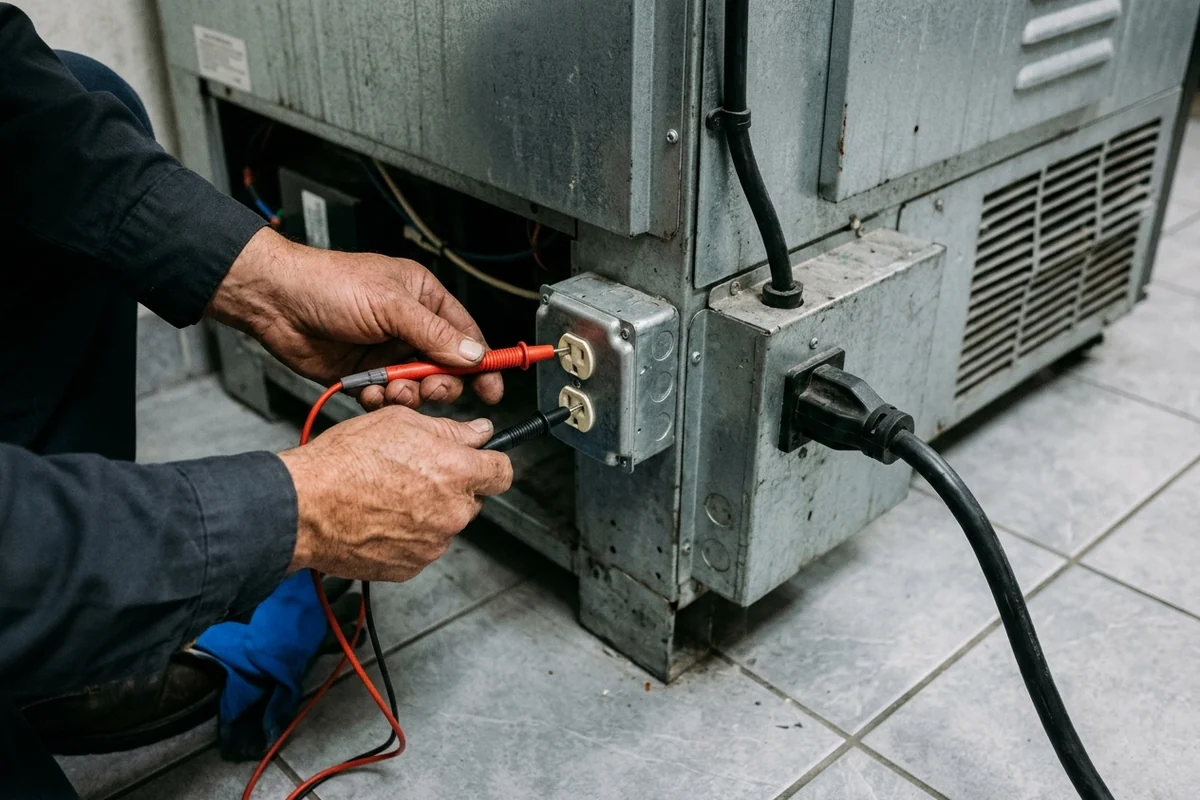
Ice cream vending machine project options — Separate the sale of pre-packaged frozen products from making soft-serve ice cream at the machine.
Packaged ice cream vs soft-serve vending — Keep the evidence and the operating tasks on the chosen route, rather than treating one description of unattended retail as both packaged pickup and on-site preparation.
Dedicated Branch Circuit, Grounding, and Voltage Drop Prevention
The USI/VendNet 3576 service manual states that for proper operation of any equipment utilizing electronically controlled components, the equipment should be placed on an isolated or dedicated noise-free circuit, properly polarized and grounded. The Fastcorp F631 manual likewise states that the F-631 requires a 115V, 15 Amp dedicated circuit, noting that lower voltage may result in vacuum-related difficulties, improper coin acceptance, or freezer malfunction.
On the Fastcorp F631, an internal gang outlet is located in the lower left corner of the cabinet below the freezer. Inside the Fastcorp F631 power box in the center base of the door, fuse F3 (2.0 Amps) protects the computer board, fuse F1 (1.5 Amps) protects the A/C motors, and fuse F2 (10 Amps) protects the vacuum motor. Fastcorp states that vacuum pressure is preset at the factory for optimum balance between vacuum pressure and product weight, however voltage variances will alter vacuum pressure.
In the Embraco Compressors Handbook (Table 4.4), a 115V 60Hz single-phase compressor (code G) has a voltage working range of 103V to 127V and a minimum start voltage of 98V. For a 208-230V 60Hz single-phase compressor (code D), Table 4.4 specifies a voltage working range of 187V to 244V and a minimum start voltage of 177V. For a 220-240V 50Hz single-phase compressor (code A), Table 4.4 specifies a voltage working range of 198V to 254V and a minimum start voltage of 187V. The USI/VendNet 3576 troubleshooting guide similarly specifies an acceptable power source range of 103-127VAC for 115V (60Hz), or 195-255VAC for 230V (50Hz).
In the Embraco Compressors Handbook, when suction and discharge pressures are unbalanced at the compressor start, it is necessary to use a high starting torque compressor (HST). Embraco notes that a voltage-raising transformer should have a capacity at least 2.5 times the compressor rated VA. Embraco also states that hermetic compressor motors have Locked Rotor Amps (LRA) even more than 10 times the Full Load Amps (FLA). When electrical motor stall occurs due to abnormal pressure or low voltage after starting, the starting relay switches on and off repeatedly, overheating the electrical motor or starting capacitor before the overload protector trips. Compressors with PTC starting devices must be restarted after a minimum time of 5 minutes from their off cycle to allow a temperature reduction sufficient to reset conductivity. Normally in a well-designed system, on-cycles of 5-7 minutes after starting are sufficient for oil returning to the compressor. When a compressor thermal/current overload protector (OLP) trips, resetting may require even more than 1 hour for an internal OLP.
The USI/VendNet 3576 service manual specifies that its power cord is a 14 gauge cord fastened to the rear mounting box so it stays with the machine and does not get changed with a lighter gauge cord. USI/VendNet instructs installers to position the vendor in its place of operation no further than nine feet from the power outlet or receptacle. The USI/VendNet 3576 manual explicitly warns that extension cords can cause problems: DO NOT USE EXTENSION CORDS.
For higher-wattage soft-serve machines, the ZM-series manual requires putting the machine still for 24 hours after transportation before using it and specifies that the power wire should not exceed 10 m. The ZM-series manual also requires that the socket is connected to the ground and that the power supply has a circuit-breaker or any other device for protection against electric shock. For conductor sizing, the ZM-series manual specifies a power cord copper core cross-sectional area of a >= 2.5 mm² for 18L and 20L machines and a >= 4 mm² for 36L and 48L machines. The ZM-series manual states that an under-size power cord can result in low voltage and overload, which affect machine performance or cause damage.
Condenser Airflow Path, Wall Clearance, and Alcove Heat Rejection
In the USI/VendNet 3576 troubleshooting manual, a refrigerated space that is too warm is traced to restricted condenser airflow, a plugged or dirty condenser, bad condenser motor or blades, a stuck blade, restricted condensing space, or a unit placed too close to a wall. In Table 12.1 of the Embraco Compressors Handbook (Item 5.3), a unit that runs but short-cycles on high-pressure cut-out is caused by insufficient air or water supply to the condenser. In Table 11.4 of the Embraco Compressors Handbook, maximum discharge gas pressures are stated at a 55°C condensing temperature with a maximum pull-down peak at a 60°C condensing temperature. For R404A in Table 11.4 of the Embraco Compressors Handbook, the maximum stated pressure is 24.7 bar (2.5 MPa) and the pull-down maximum peak is 27.7 bar (2.8 MPa) with a 130°C maximum discharge gas temperature. For R290 in Table 11.4 of the Embraco Compressors Handbook, the maximum stated pressure is 18.1 bar (1.8 MPa) and the pull-down peak is 20.2 bar (2.0 MPa) at a 130°C maximum discharge gas temperature. For R134a in Table 11.4, the maximum stated pressure is 13.9 bar (1.4 MPa) and the pull-down peak is 15.6 bar (1.6 MPa) at a 130°C maximum discharge gas temperature.
The USI/VendNet 3576 service manual instructs installers to leave at least 6-inches of clear air space behind the vending machine. USI/VendNet also specifies that the vendor is suitable for indoor use only within a recommended operating temperature between 40° and 100° Fahrenheit (4° and 38° Celsius).
The ZM-series soft-serve manual specifies working conditions of 5-40 °C ambient temperature and 2-35 °C mixture temperature. For placement, the ZM-series manual instructs installers to make sure the machine is in good ventilation, avoiding heat sources or sunlight, with air outlets of the machine at least 1 m away from walls or any other barriers and other sides at least 0.5 m away from any barrier. In the ZM-series troubleshooting table, insufficient heat dissipation space is listed as a direct cause when ice cream is too soft.
On the Taylor Model 161 compact twin-twist freezer, the spec sheet requires a minimum clearance of 6 inches (152 mm) on the left and right, and 0 inches in the rear. On the Taylor Model 702 single-flavor freezer, the spec sheet requires a minimum of 6 inches (152 mm) on both sides, instructing installers to install the skirt provided on the right side of the unit and place the back of the unit against the wall to prevent recirculation of warm air. On the Taylor Model 337 twin-twist freezer, the spec sheet likewise requires a minimum of 6 inches (152 mm) on both sides, installing the skirt provided on the right side of the unit and placing the back of the unit against a wall to prevent recirculation of warm air.
On the Taylor Model C707 single-flavor freezer, the spec sheet requires a minimum of 6 inches (152 mm) on both sides and placing the back of the unit against a wall to prevent recirculation of warm air. On the Taylor Model C706 single-flavor pump freezer, the spec sheet requires a minimum of 6 inches (152 mm) on both sides and placing the back of the unit against a wall to prevent recirculation of warm air. On the Taylor Model C707, an optional air discharge chute directs heated air exhaust upwards, and no clearance is required on the right side if the air discharge chute is used. On the Taylor Model C706, an optional air discharge chute directs heated air exhaust upwards, and no clearance is required on the right side if the air discharge chute is used. On the full-size Taylor Model C712 floor model, the spec sheet requires a minimum of 3 inches (76 mm) around all sides and specifies installing the deflector provided to prevent recirculation of warm air. On the full-size Taylor Model C713 floor model, the spec sheet requires a minimum of 3 inches (76 mm) around all sides and specifies installing the deflector provided to prevent recirculation of warm air.
Within the compressor compartment, the Embraco Compressors Handbook (Figure 10.1.3.7) specifies that the fan motor shall be placed at 30 cm ± 1 cm from the compressor with airflow oriented to the lateral side. Embraco warns that the overload protector (OLP) must not be in direct contact with the forced air.
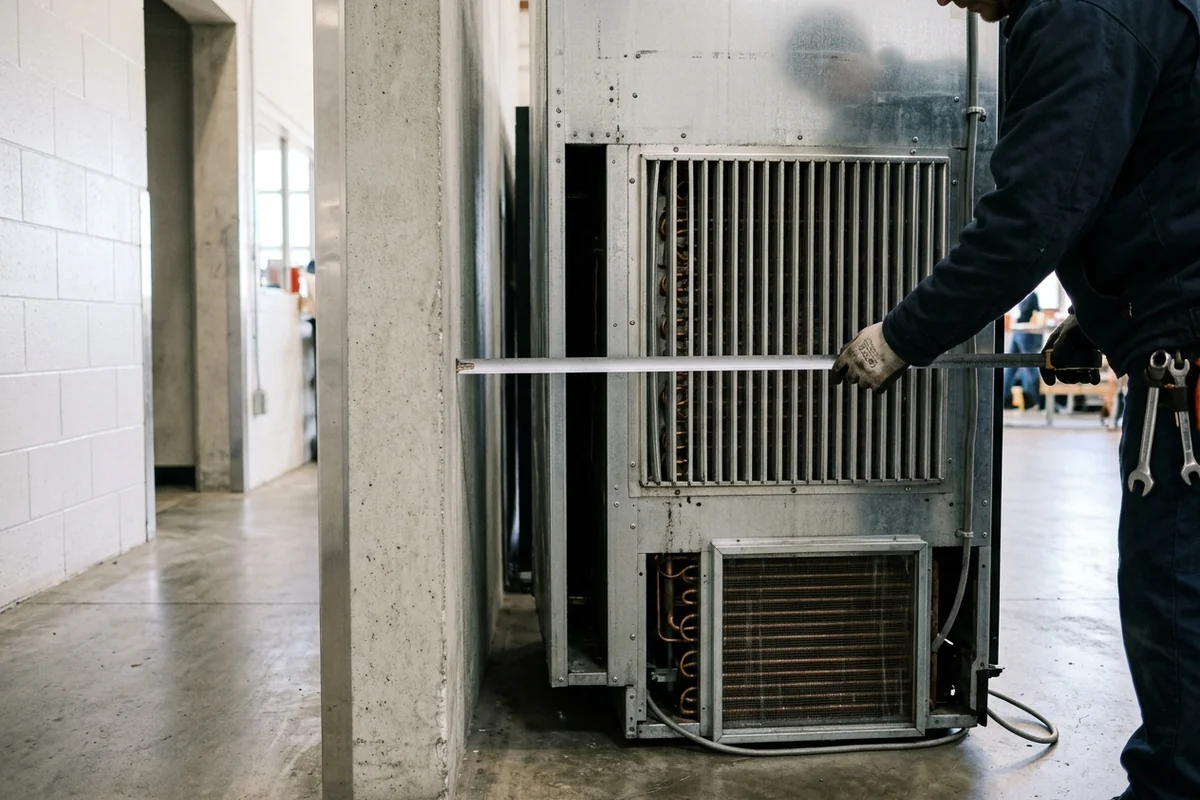
Pre-Installation Site Audit and Condenser Maintenance Checklist
The site-survey checklist separates general access and utilities from the requirements of wet-area, refrigerated, heated-preparation, and dry-product equipment. On the USI/VendNet 3576, the service manual requires that before connecting the vendor, the integrity of the main electrical supply must be checked for correct polarity, presence of ground (earth), and correct voltage. USI/VendNet specifies that these checks should be repeated at six (6) month intervals with the routine safety electrical testing of the vendor itself.
The ZM-series soft-serve manual instructs operators to place the machine on an even plain ground and lock the brakes. The ZM-series manual also requires putting the machine still for 24 hours after transportation before using it. On the Fastcorp F631, the user manual states that two or three hours after powering the machine, the freezer temperature should be around -15ºF/-26ºC. The Fastcorp F631 range of operation temperature is -25ºF/-31ºC to 15ºF/-9ºC (at 70ºF/21ºC ambient).
In the ZM-series soft-serve manual, after serving for a certain period of time, dust will cover the condenser and affect refrigeration with the symptom that ice cream hardness decreases in the same running time. The ZM-series manual instructs operators to wash the condenser at least once in 3 months (or once a month in a worse condition). On the Taylor Model 161, an easily removable, cleanable air filter helps keep the condenser clean for optimal refrigeration system performance. On the USI/VendNet 3576, the service manual states a caution to replace the air filter every 3 months to maintain proper air circulation to the condenser and prevent dirt and debris from clogging up the condenser. The USI/VendNet 3576 manual warns not to replace the refrigeration air filter with a HEPA type filter because that type may not allow the correct amount of air to flow through. Every 6 months on the USI/VendNet 3576, operators must remove the Back Screen Cover from the cabinet back and clean dust and debris from the screen using a soft bristle brush or a vacuum cleaner. On the USI/VendNet 3576, technicians check if the condenser fan is running by folding a sheet of 8 1/2 inch by 11 inch paper in half and placing the paper in front of the condenser coil inlet screen located on the bottom right side underneath the cabinet to see if it draws the paper to it. USI/VendNet also instructs operators to check that the condenser coil is free of dust and dirt and that the compressor is free of dust, because a blanket of dust can prevent the compressor from cooling in between workout cycles.
On the Fastcorp F631, the cabinet can typically be unplugged for up to 12 hours without harming the product. On the Fastcorp F631, the N.S. Health Switch prevents operation of the machine if the temperature rises above 15ºF, requiring the F631 to be manually reset. On the USI/VendNet 3576, the Health Safety feature prevents the sale of perishable food if the air temperature inside the Food Vendor compartment rises above the Health Safety temperature limit for more than 15 minutes. Record the alert, sales restriction, and stock decision as separate frozen-vending checks.
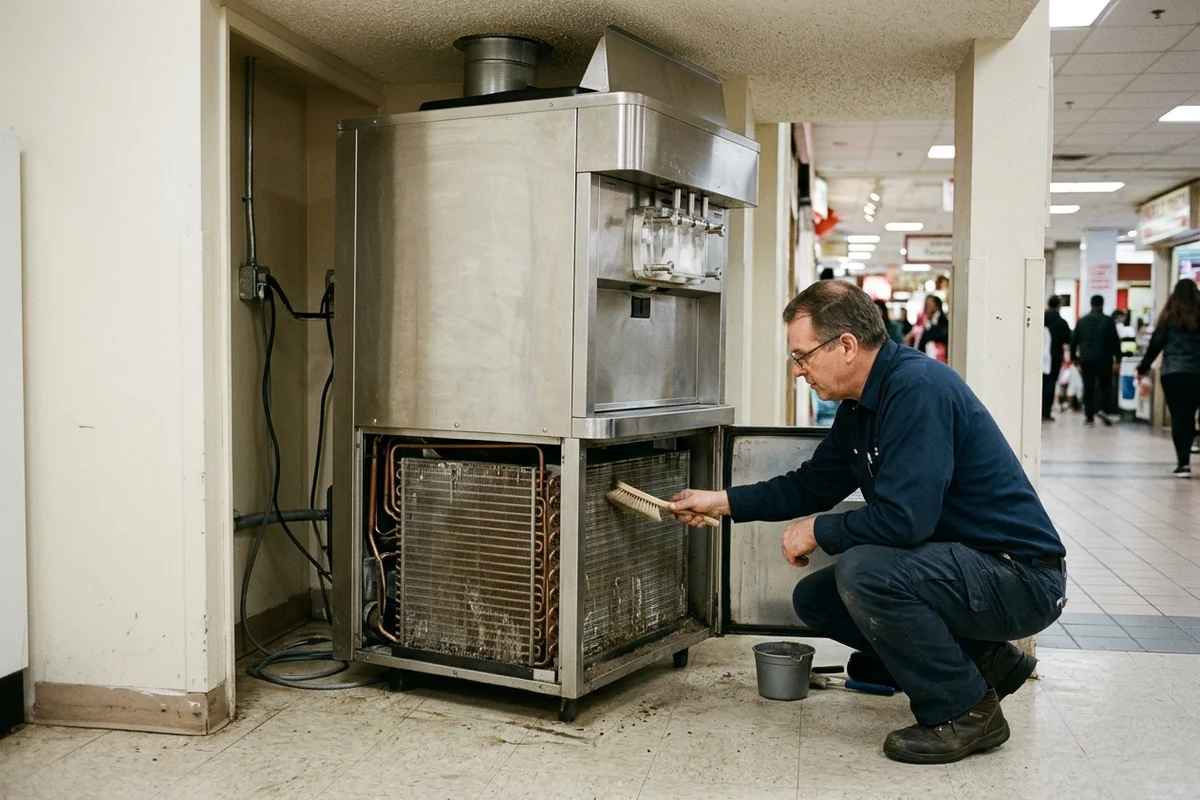
Frozen vending temperature and fault checks — Record the alert, sales restriction and stock decision as separate frozen-vending checks.
Equipment engineering resources — The site-survey checklist separates general access and utilities from the requirements of wet-area, refrigerated, heated-preparation and dry-product equipment.
Frequently asked questions
Can a commercial ice cream vending machine run on a standard 15-amp 115V receptacle?
The Fastcorp F631 robotic frozen merchandiser requires a 115V, 15 Amp dedicated circuit, where lower voltage may result in vacuum-related difficulties, improper coin acceptance, or freezer malfunction. The Fastcorp F631 weighs 635 lbs (288 kg) and has an amp draw of 2.5 Amps resting and 10 Amps operating. Spiral cold/frozen vendors such as the USI/VendNet 3576 operate at 115 VAC, 60 Hz, 9.0 Amps nominal or 230 VAC, 50 Hz, 4.5 Amps nominal. By contrast, commercial soft-serve freezers such as the Taylor Model C707 require a 208-230/60/1 Air (2P 3W) circuit with 25 A minimum circuit ampacity and a 35 A maximum fuse size. Dual-cylinder twist soft-serve freezers such as the Taylor Model C713 require two dedicated 208-230/60/1 Air (2P 3W) connections rated at 25 A left and 23 A right minimum circuit ampacity with 35 A left and 35 A right maximum fuses.
Why do frozen vending manuals prohibit extension cords and undersized supply wiring?
The USI/VendNet 3576 service manual warns that extension cords can cause problems: DO NOT USE EXTENSION CORDS. The USI/VendNet 3576 provides a 14 gauge power cord fastened to the rear mounting box so it does not get changed with a lighter gauge cord. USI/VendNet also instructs installers to position the vendor no further than nine feet from the power outlet or receptacle. The ZM-series soft-serve manual specifies a power cord copper core cross-sectional area of a >= 2.5 mm² for 18L and 20L machines and a >= 4 mm² for 36L and 48L machines. The ZM-series manual warns that an under-size power cord can result in low voltage and overload, which affect machine performance or cause damage. According to the Embraco Compressors Handbook, electrical motor stall due to abnormal pressure or low voltage after starting causes the starting relay to switch on and off repeatedly, overheating the electrical motor or starting capacitor before the overload protector trips.
How much wall clearance does an automatic ice cream vending machine need for condenser airflow?
The USI/VendNet 3576 frozen food vendor requires at least 6-inches of clear air space behind the vending machine. Taylor air-cooled soft-serve freezers such as the Model C707 require a minimum of 6 inches (152 mm) on both sides with the back of the unit placed against a wall to prevent recirculation of warm air. On the Taylor Model C707, an optional air discharge chute directs heated air exhaust upwards and no clearance is required on the right side if the air discharge chute is used. Full-size Taylor twist freezers such as the Model C713 require a minimum of 3 inches (76 mm) around all sides with the provided deflector installed to prevent recirculation of warm air. ZM-series soft-serve manuals specify that air outlets of the machine should be at least 1 m away from walls or any other barriers and other sides should be at least 0.5 m away from any barrier.
What happens when condenser coils clog with dust or exhaust heat recirculates in an alcove?
In the Embraco Compressors Handbook (Table 12.1 Item 5.3), insufficient air or water supply to the condenser causes the unit to short-cycle on the high-pressure cut-out. In the ZM-series soft-serve manual, dust covering the condenser affects refrigeration with the symptom that ice cream hardness decreases in the same running time. The ZM-series manual requires washing the condenser at least once in 3 months (or once a month in a worse condition). On the Fastcorp F631, the N.S. Health Switch prevents operation of the machine if the temperature rises above 15ºF, requiring the F631 to be manually reset. On the USI/VendNet 3576, the Health Safety feature prevents the sale of perishable food if the air temperature inside the Food Vendor compartment rises above the Health Safety temperature limit for more than 15 minutes.