

Self-Service vs Automatic Dog Wash Machines
Assess the current owner-operated dog wash route by who positions the dog, controls washing and drying, and provides help. Any requested automatic action needs evidence for a separately defined proposal.
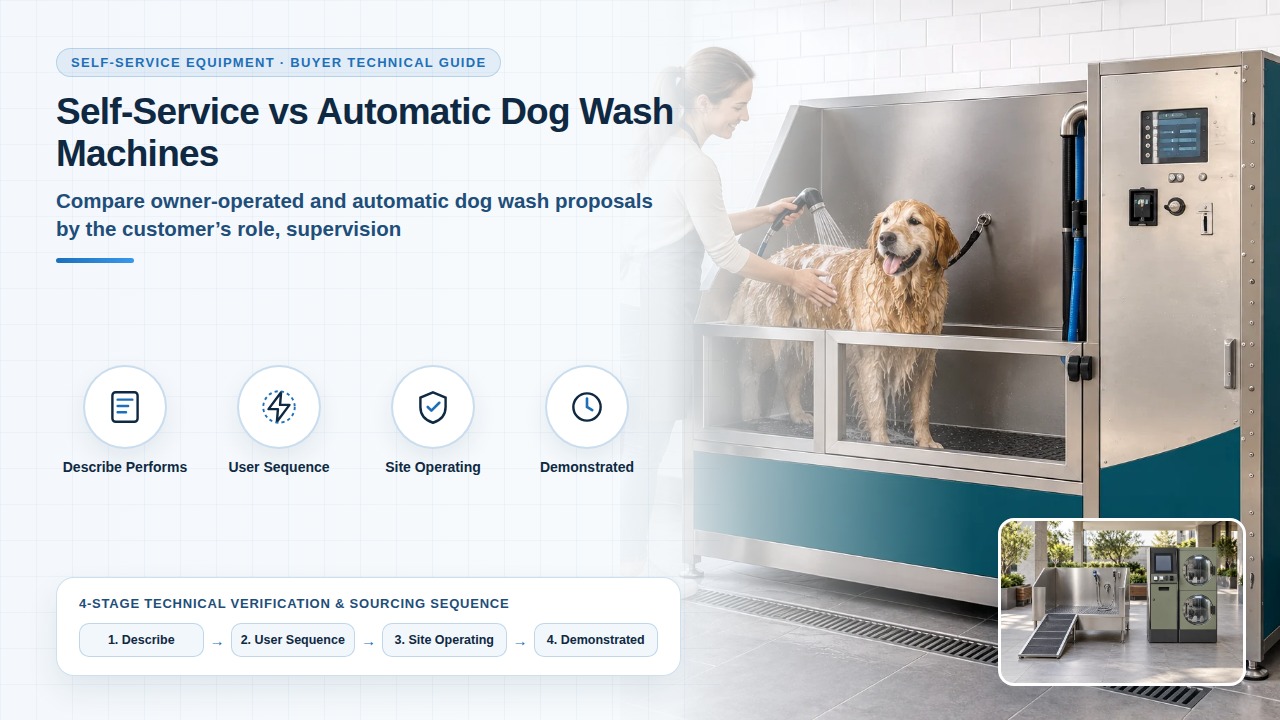
Describe who performs each part of the wash
Start by mapping the customer's role rather than relying on the words self-service or automatic. Identify who positions the dog, applies the wash, controls the sequence and performs drying. SelfServiceMachines currently frames this category around owner-operated wash stations.
Commercial Self-Service Dog Wash Stations — Input for the owner-operated side of this comparison: that page records the owner guiding the dog, the wash the owner controls, and a demonstration through washing and drying.
Dog Wash Equipment Cost & Installed Budget — Next step when this comparison stays on the owner-operated route: keep the equipment quote separate from site works, transport and operating costs.
Owner, equipment and site staff
- 1. Position. Owner: Positions the dog. Equipment: User-operated station. Site staff: Attendant if assigned.
- 2. Wash. Owner: Applies the wash. Equipment: Controls the owner uses. Site staff: Help when assigned.
- 3. Dry. Owner: Performs drying. Equipment: Control the owner uses. Site staff: Help when assigned.
- 4. Stop. Owner: Stops or requests help. Equipment: User stop control. Site staff: Supervision and help.
Compare the user sequence and supervision
For each proposed route, request the intended operating sequence and the documented conditions of use. This comparison applies to the animal and the setting named in that sequence. Clarify supervision, assistance, interruptions and how the user stops a session. The handling process, protections and support arrangements are those named for that business.
Plan the cleaning task, user sequence and site together — Input before treating a dog wash as automatic: the cleaning directory starts that route with the owner guiding the animal and operating the wash, and keeps helmet cleaning as a separate project.
Compare site and operating responsibilities
Record the layout, utilities, cleaning, replenishment and local service tasks for each actual proposal. For a business already offering staffed pet services, explain how the proposed equipment would fit that operation. For a public amenity, clarify access, help and daily checks. The comparison should use the real operating model rather than only the equipment purchase line.
Choose what must be demonstrated
Assess owner-operated stations and requested automatic functions separately. List each proposed action, its demonstration and the responsible operator in the review. The written quotation identifies the configuration available to order.
Frequently asked questions
Does a timed or per-session payment make the dog wash fully automatic?
A session charge is a payment arrangement, separate from who washes and dries the dog. The commercial dog wash stations page asks whether customers pay for each session or use the station as an included amenity. For paid use it asks for the terminal, acquiring account, currency and refund process for the destination country, and for a demonstration from payment through washing and drying to shutdown. On that route the owner guides the dog and controls the washing process. This comparison still records who positions the dog, who controls washing and drying, and who provides help. Any automatic action needs evidence for a separately defined proposal. The cleaning directory starts the dog-wash route with the owner guiding the animal and operating the wash functions.
Who operates washing, and who operates drying?
On the current owner-operated route, record who applies the wash and who performs drying as separate actions. The commercial stations page describes the owner guiding the dog and controlling the washing process, and asks for a continuous demonstration from payment through washing and drying to shutdown. Drying stays on that user sequence unless a proposal lists drying as its own action and demonstrates it separately. The written quotation identifies the configuration available to order.
Can an automatic function that has not been demonstrated be quoted as an available capability?
The written quotation names the configuration available to order, and it names any offered automatic action together with its operating conditions. This page keeps the current category on owner-operated stations and uses a separate proposal and capability review, with availability unconfirmed. The cleaning directory keeps the dog-wash route as the owner guiding the animal and operating the wash functions. The dog wash cost page keeps the equipment quote separate from site works, transport and operating costs for that owner-operated budget. A function without that demonstration stays in the separate proposal.