

Robotic Ice Cream Vending Machine: Cone, Cup and Jam Points
Compare cone and cup dispensing mechanisms, photoelectric cup-station sensors and field jam points for a robotic ice cream vending machine project. Prepare the consumable, dispenser and acceptance details for your quotation.
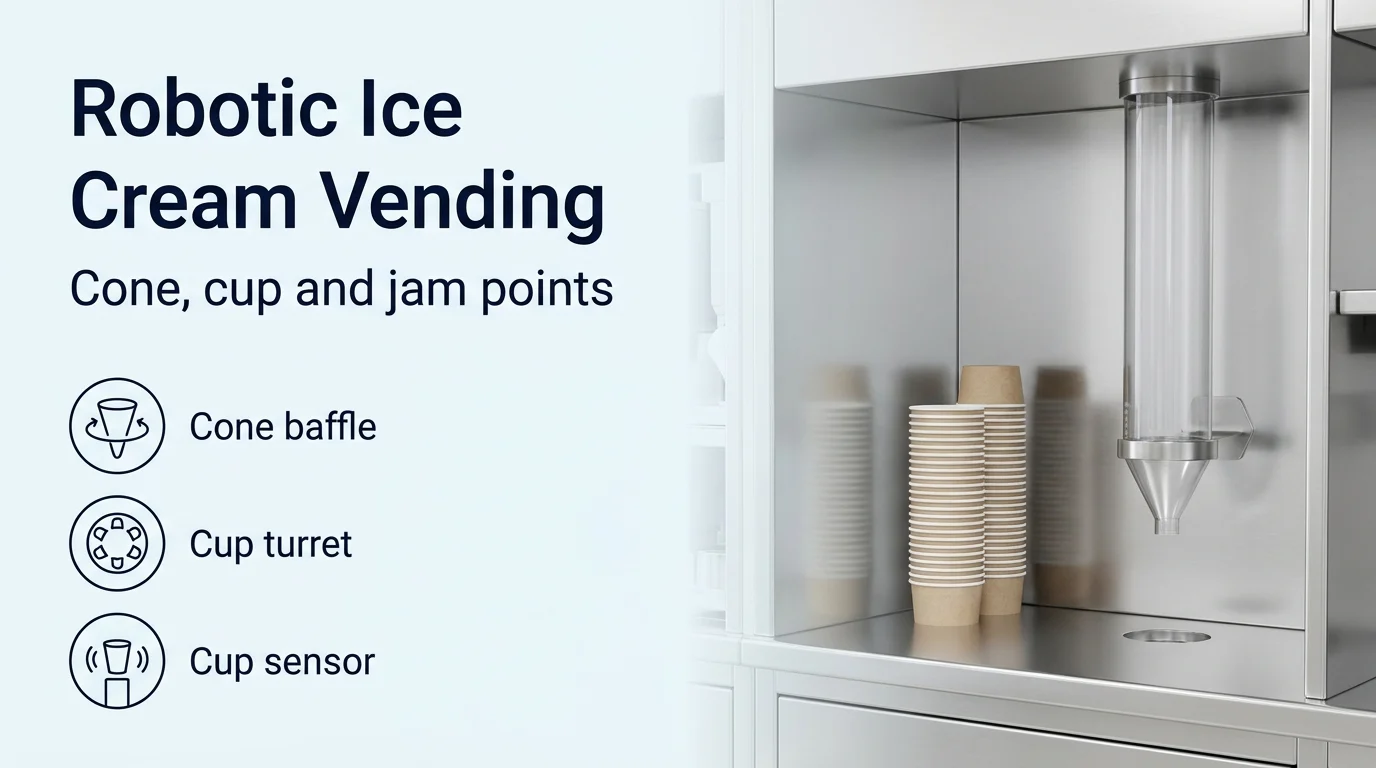
Separate soft-serve cup kiosks, cone dispensers and packaged robotic freezers
For a robotic ice cream vending machine project, separate pre-packaged frozen-product retrieval from on-site soft-serve dispensing into an open cup or cone. Confirm the consumable format and the dispensing mechanism in the written proposal before comparing cycle speed or capacity.
On SelfServiceMachines.com, packaged frozen-product vending is configured around packaging fit, storage conditions, and replenishment, whereas soft-serve preparation is reviewed separately for ingredients, cleaning, utilities, and local operation.
On SelfServiceMachines.com, robotic handling, heat treatment, and other processing functions stay outside the default proposal unless the documented model scope includes them.
Under Wis. Admin. Code ATCP 75 Appendix 4-904.11(A), single-service and single-use articles and cleaned and sanitized utensils shall be handled, displayed, and dispensed so that contamination of food- and lip-contact surfaces is prevented.
Under Wis. Admin. Code ATCP 75 Appendix 4-904.11(C), except as specified under (B), single-service articles that are intended for food- or lip-contact shall be furnished for consumer self-service with the original individual wrapper intact or from an approved dispenser.
Explore ice cream vending machines — Discuss your packaged frozen or soft-serve equipment scope with SelfServiceMachines.
Compare packaged and soft-serve vending routes — Review ingredient handling, cleaning and replenishment tasks across both operating routes.
Cone dispensing: gravity tubes, silicone baffles and waffle-cone loading
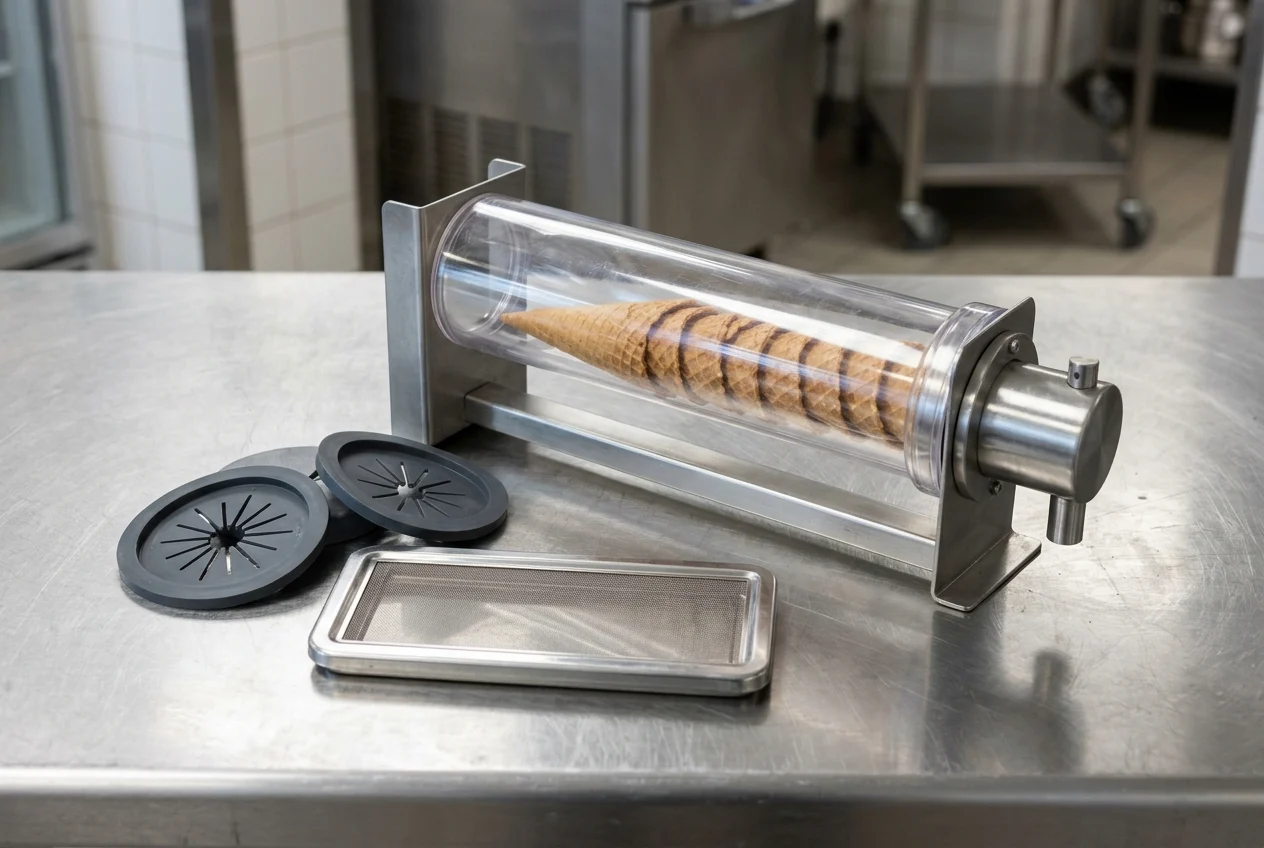
When evaluating an ice cream vending cone dispenser or counter sub-assembly, check how the tube supports the cone lip, how fragile cones are loaded and how crumbs are collected.
In the Modular Simpli-Flex cone dispenser manual, gravity fed dispensers may be mounted in any position from vertical to 55° from vertical.
The Modular SIMPLI-FLEX dispenser model 1002 is completely self adjusting and can dispense virtually any shape of ice cream cone.
In the Modular Simpli-Flex cone dispenser manual, to load flat bottom cones it is not necessary to remove the dispenser from the mounting location; unwrap cones and gently drop them into the dispenser tube.
In the Modular Simpli-Flex cone dispenser manual, to load Waffle Cones or other heavy, fragile cones, remove the dispenser from its mounting location, lay it on a clean flat surface, and carefully slide the stack of cones into the dispenser tube.
The Modular SIMPLI-FLEX cone dispenser manual states that all ice cream cones will chip and flake slightly, and the dispenser can be completely disassembled without tools.
On Dispense-Rite GFCD Series cone dispensers, the lid, clamp, and gasket are cleaned in hot, soapy water and are not dishwasher safe.
The Dispense-Rite BCDS-BFL Boxed Cone Dispenser includes three baffle plate inserts and two collar adapters to provide compatibility with most popular boxed cone sizes.
In the Dispense-Rite BCDS-BFL setup guide, if cones are difficult to remove or fall through on their own, verify that you have installed the correct baffle plate for your cone size.
Robotic end-of-arm tooling: soft-polymer fingers and vacuum pickers
Compare how the robotic end-of-arm tooling grips open baked cones, single-service cups or sealed frozen packages during transfer.
Soft Robotics mGrip kits are offered in Standard (Aluminum) and Food Safe (Stainless Steel) options. Food Safe mGrip kits are compliant with (EC) 1935:2004 and United States FDA 21 CFR for food contact.
The Soft Robotics mGrip soft gripper handles circular objects up to 165 mm in diameter or parallel widths up to 120 mm, weights up to 3.4 kg (7.5 lbs), rates up to 120 picks per minute, and is rated IP67.
The Soft Robotics mGrip controller requires 95 psig air matching ISO 8573-1:2010 [5:5:4] quality and a 24 VDC ± 10% @ 0.5 A MAX power supply.
On the Fastcorp F631 robot, the slotted black opto-encoder disk rotates between the LED to create on/off pulses where each pulse represents approximately 1/16 of an inch of travel.
On the Fastcorp F631 robot, when the picker tip touches product, slack is created on the picker cable to turn off the up/down motor and turn on the vacuum motor; if dropped, the robot makes two additional attempts to retrieve the product.
On the Fastcorp F631, voltage variances alter vacuum pressure: too much vacuum causes the picker head to jump up as a product is touched, while too little vacuum causes the product to fall off.
If a Fastcorp F631 motor gets stuck in any direction, it will push for six seconds before shutting off with an Out of Order message on the screen.
Ask the supplier to specify the gripper mechanism, air or vacuum supply and fault recovery sequence for the quoted machine.
Cup dispensing: rotary cam-and-gear rings and clip or baffle tubes
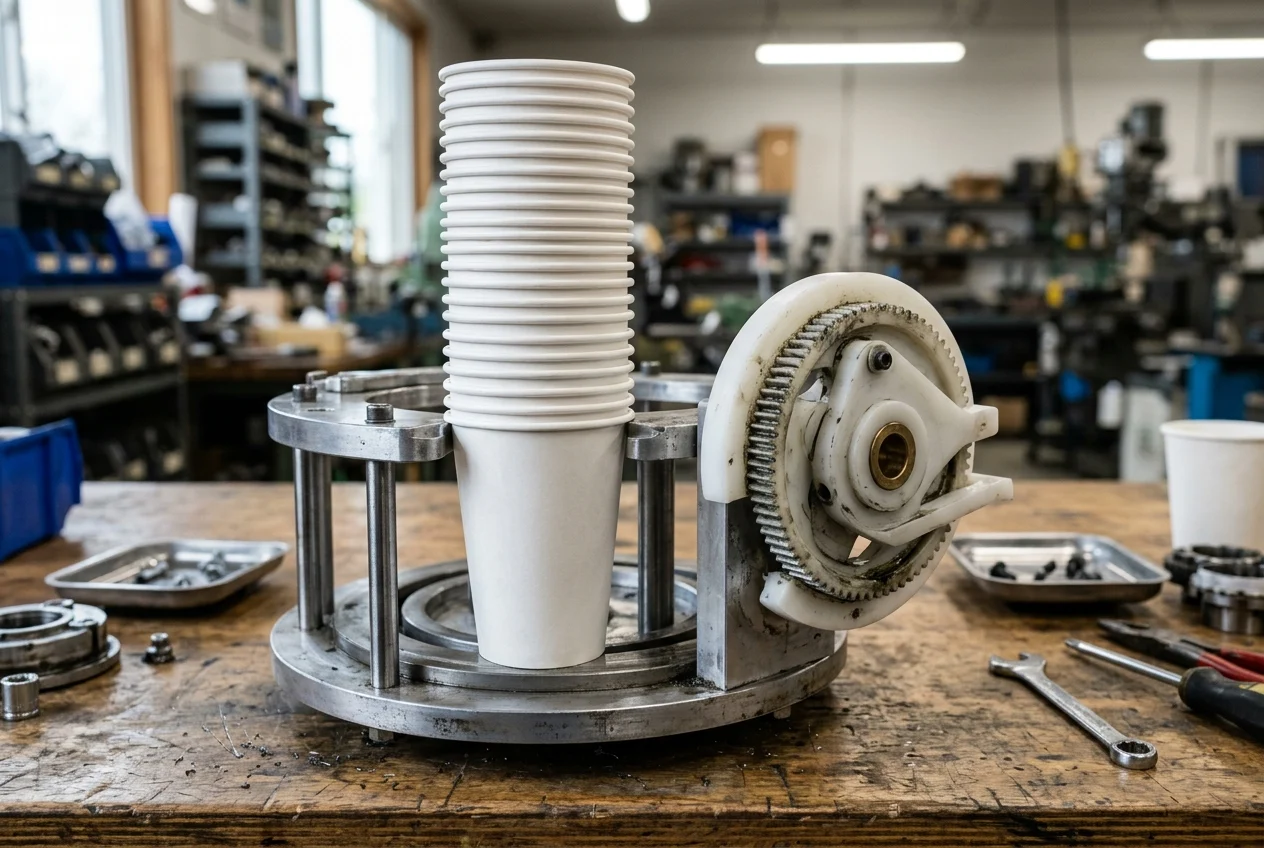
For paper, plastic or foam cups, verify whether the dispenser uses a motorized rotary cam ring or a spring-loaded tube with adjustable clips or silicone baffles.
In the National Vendors parts manual, Universal Cup Ring Assembly 6333008 contains 1 internal adjuster ring (6333011), 6 cam & gear assemblies (6333007), 6 universal cup cams (6333012), 6 18-tooth gears (6233126), and 6 10-tooth gears (6233127).
In the Crane / GPL service manual, to adjust the cup mechanism, place seven cups in the cup ring and adjust the arm so the clearance is just large enough to allow cup ejection while the opposite side is snug against the cam.
In the Crane / GPL service manual, do not fill cups above the level marked on the outside of the cup turrets or above the FILL LINE label inside each turret, or motor jams will occur.
In the Crane / GPL service manual, use only the same size and brand of hot drink cups in each turret and do not intermix.
Dispense-Rite STL Series and ADJ Series cup dispensers utilize a precision three clip adjustment mechanism to ensure the exacting fit for a particular cup or container size.
Dispense-Rite SLR Series and BFL Series cup dispensers utilize an interchangeable baffle gasket system for a self-adjusting dispenser.
Optical cup-in-place and drop verification sensors
In the Crane / GPL service manual, PosiVend ensures a cup is always available in the cup station before product is delivered using a beam of infra-red light across the cup station broken by the cup.
In the Crane / GPL service manual, PosiVend software monitors the cup station sensor during the time the cup ring is cycled and for three seconds afterward, and each ring will be tried up to two times.
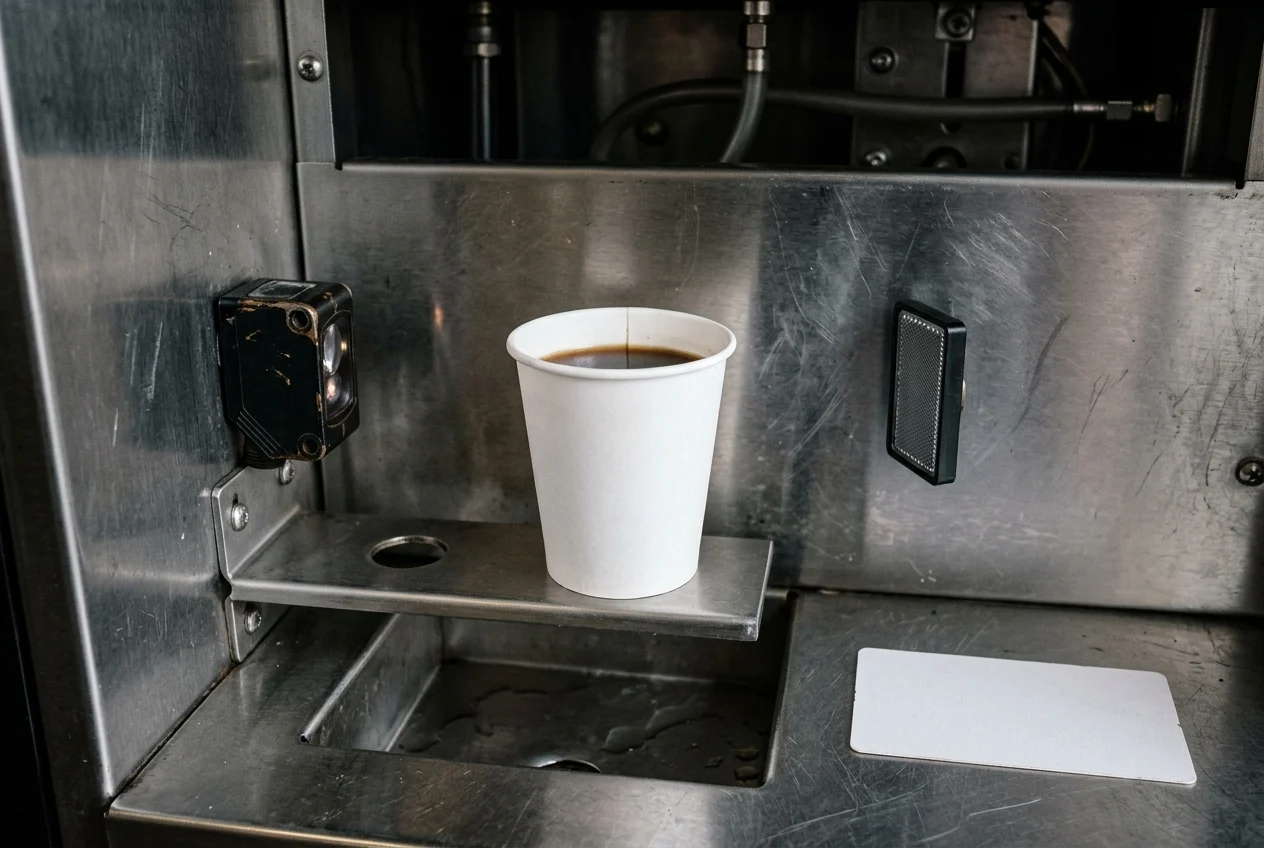
In the Crane / GPL service manual, infrared cup sensor calibration uses a 5" x 5-5/8" white poster board or heavy cardboard target standing vertically, and a slightly more sensitive setting is needed if the cup or mug is a dark color.
In the Necta Krea manual, the optional cup sensor detects the presence of objects between the reflector and the sensor in the dispensing unit.
Omron E3Z photoelectric sensors feature a sensing distance of 30 m for Through-beam Models, 4 m for Retro-reflective Models, and 1 m for Diffuse-reflective Models, with a mechanical and optical axis offset of less than ±2.5°.
Omron E3Z-D61, E3Z-D81, E3Z-D66, and E3Z-D86 wide-view diffuse-reflective photoelectric sensors have a sensing distance of 5 to 100 mm.
Omron E3Z-L68 and E3Z-L88 sensors detect transparent glasses at 30±20 mm, while E3Z-B61/E3Z-B81 (500 mm) and E3Z-B62/E3Z-B82 (2 m) retro-reflective sensors detect clear, plastic bottles.
Omron E3Z-B Series photoelectric sensors have an operate or reset response time of 1 ms max. and an IEC IP67 degree of protection.
In the USI / VendNet service manual for the iVend Sensor System, if a product is not detected when the motor reaches home, it pauses 1 second, runs a second vend cycle, monitors for 2 seconds after stopping, and if no product is detected marks the selection sold out.
Field jam points, false sensor lockouts and freezer cylinder checks
Include cup-station sensor cleaning, auger fit and cylinder mix level checks in the daily operator routine.
In the Crane / GPL service manual, a false mug display with no cup in the station indicates improper cup station alignment, excessive sensitivity sensing the delivery door, or an unclean dark colored infrared mug/cup sensor lens.
On ZM-A168, A200, A360/A480, and A121 soft-serve machines, the mixture level in neither cylinder should be lower than the inlet of the discharger, with default cycle restart time P0 set to 5 minutes and shutdown mixing delay P1 set to 15 seconds.
In the USI / VendNet service manual, the size of the item being vended must be larger than the diameter of the auger being used, and each auger can be rotated in 20° (degree) increments.
Assign a local operator to inspect the cup turret, cone baffle, sensor lens and freezer mix level during each replenishment visit.
Check ice cream vending power and condenser clearance — Review branch circuit sizing, voltage drop limits and condenser airflow requirements.
Review frozen vending temperature and fault checks — Separate cabinet temperature alerts and stock disposition from dispensing mechanism faults.
Prepare a robotic ice cream vending machine quotation request
Send SelfServiceMachines your target consumable format (paper cup, clear plastic cup, flat-bottom cake cone, waffle cone or sealed frozen novelty package), cup or cone rim diameter, daily serving volume and site location. Include the available electrical supply, installation area, replenishment schedule and local maintenance operator.
Request an itemized quotation covering the dispensing mechanism, cup turret or cone baffle sizing, optical cup-in-place interlock, payment hardware, freight and commissioning scope. Attach your sample cup or cone drawing and your demonstration acceptance checklist so every proposal is evaluated on the same operating route.
Sources
- SelfServiceMachines.com — Ice Cream Vending Machines Category Hub
- SelfServiceMachines.com — Packaged vs. Soft-Serve Ice Cream Vending
- Cornell Law School LII — FDA Food Code Kitchenware and Tableware
- Sweet Robo LLC — Robo Ice Cream Product Page
- Gumball.com — Robo Ice Cream Vending Machine Specification Page
- Guangzhou Huaxin Industrial Co., Ltd. — Robot Ice Cream Vending Machine
- VLT Robotics — CafeXbot Ice Cream Robot Product Page
- Foodmax Machines — Robot Ice Cream Machine Product Page
- Modular Dispensing Systems — Simpli-Flex Cone Dispenser Instruction Manual
- Dispense-Rite — GFCD Series Cone Dispenser Installation Instructions
- Dispense-Rite — BCDS-BFL Boxed Cone Dispenser Setup Guide
- Dispense-Rite — Commercial Cup, Lid & Cone Dispenser Catalog
- Soft Robotics Inc. / SMC Corporation — mGrip Technical Specification Sheet
- Fastcorp Vending LLC — Divi Robotic Frozen Vending Machine User Manual
- National Vendors (Crane Co.) — Hot Drink Merchandiser Parts Manual
- Crane Merchandising Systems / GPL — Hot Drink Merchandiser Setup and Service Manual
- Necta (Evoca Group) — Krea Installation, Use and Maintenance Manual
- Omron Industrial Automation — Compact Photoelectric Sensor Datasheet
- USI / VendNet — Frozen Food and Ice Cream Merchandiser Service Manual
- Commercial Soft Serve Ice Cream Machine User Manual