

Soft Ice Cream Vending Machine: Pasteurization, Hopper Cooling and Cleaning
Compare automatic heat treatment cycles, separate mix hopper refrigeration, lockout rules and daily sanitation steps for a commercial soft ice cream vending machine. Prepare your ingredient, cleaning and local operator details before requesting a quotation.
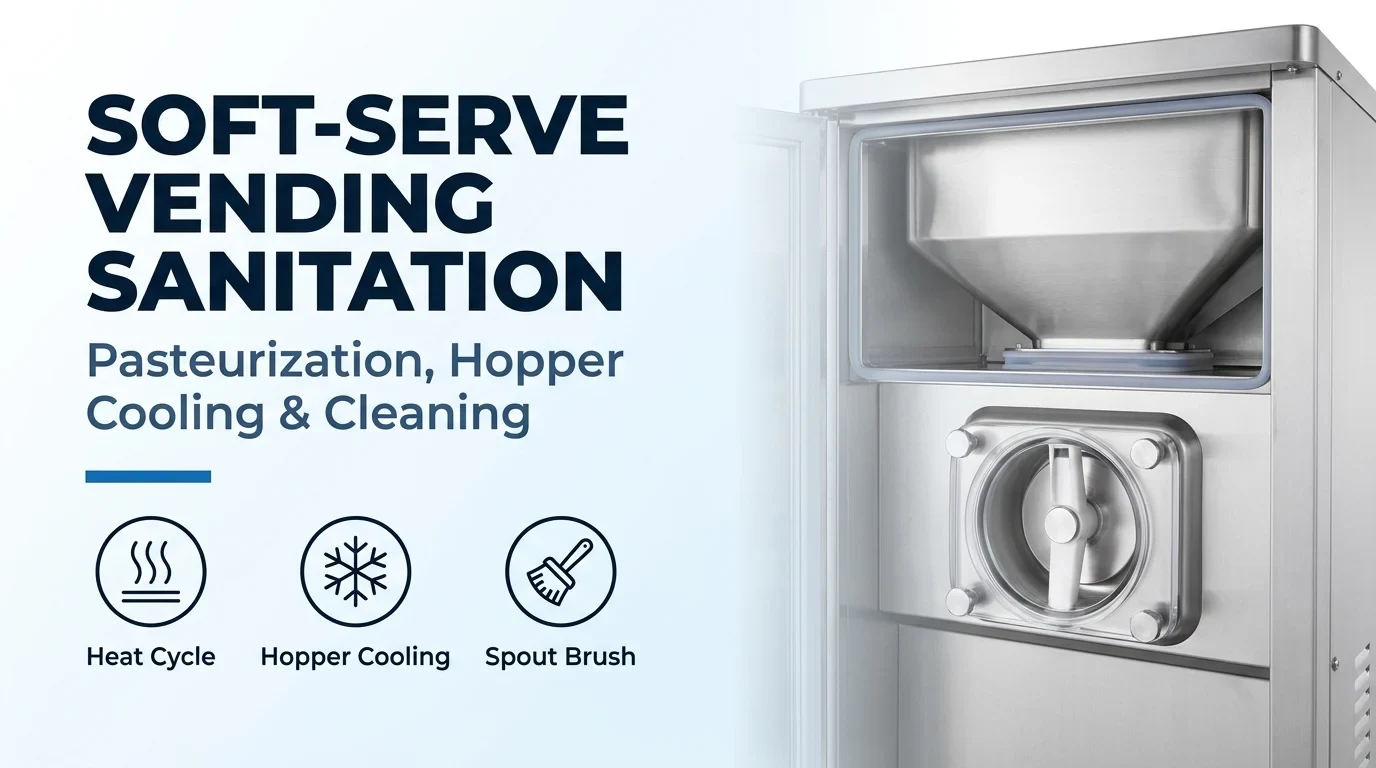
Nocturnal automatic heat treatment cycles and phase timing limits
When evaluating a soft ice cream vending machine or a commercial ice cream vending machine for unattended venues, distinguish sealed novelty retrieval from fresh liquid dairy preparation and verify whether an automatic heat treatment cycle is included in the written machine scope.
On SelfServiceMachines.com, operators configure packaged frozen-product vending around packaging fit, storage conditions and replenishment, and review soft-serve preparation separately for ingredients, cleaning, utilities and local operation.
For soft-serve preparation on SelfServiceMachines.com, the local file is the ingredients, the preparation sequence and the model cleaning documents, plus the person who carries out that cleaning and handles an interruption.
On SelfServiceMachines.com, robotic handling, heat treatment and other processing functions stay outside the proposal unless the documented model scope includes them.
In the Heat cycle on Taylor Models C708 and C716 Heat Treatment soft-serve freezers, the mix temperature in the hopper and freezing cylinder must be raised to 151°F (66.1°C) within 90 minutes.
When the heating phase is complete on Taylor Models C708 and C716, the holding phase keeps the temperature above 151°F (66.1°C) for a minimum of 35 minutes.
On Taylor Models C708 and C716, the HEAT time indicates the amount of time taken in each zone to reach 150.9°F (66.1°C), and each zone must remain above 150°F (65.6°C) for a minimum of 35 minutes.
In the final Cooling phase of the Heat Treatment Cycle on Taylor Models C708 and C716, the freezer must cool the mix below 41°F (5°C) within 90 minutes.
On Taylor Models C708 and C716, TOTAL TIME FAILURE indicates that the maximum allowable total Heat Treatment time exceeded 4 hours.
During the Heat Treatment Cycle on Taylor Models C708 and C716, the warning message DO NOT DRAW is displayed on the screen when the mix temperature is below 130°F (54.4°C).
During the Heat Treatment Cycle on Taylor Models C708 and C716, when the mix temperature is above 130°F (54.4°C), the screen displays a message indicating that HOT PRODUCT is in the machine.
Explore ice cream vending machines — Review packaged novelty and fresh soft-serve equipment options with SelfServiceMachines.
Compare packaged and soft-serve vending routes — Check how ingredient handling, cleaning tasks and proposal boundaries differ between both formats.
Hard lock versus soft lock, thermal excursion thresholds and inspector audit logs
On SelfServiceMachines.com, operators record any sales restriction that is actually demonstrated and keep the displayed value, the alarm, the cleared fault and the stock decision as separate records.
On Taylor Models C708 and C716, a hard lock requires the machine to be disassembled and brush-cleaned, while a soft lock can be corrected by either disassembling and brush-cleaning the machine or by starting another Heat Treatment Cycle.
On Taylor Models C708 and C716, the freezer will hard lock if either the Brush Clean Timer has elapsed or if a thermistor failure (freezing cylinder or hopper) occurred during a Heat cycle.
On the Taylor Model C606 Heat Treatment freezer, a hard lock failure occurs when the brush-clean timer has elapsed (maximum setting of 14 days).
To clear a brush-clean lockout on Taylor Models C708 and C716, the freezer must be disassembled to activate the 5-minute timer on the display screen, and once the timer counts down to zero, the lockout is cleared.
On Taylor Models C708 and C716, if a Heat Treatment Cycle has not been initiated within the last 24 hours, a soft lock failure will occur.
On Taylor Models C708 and C716, a soft lock can occur during operation when the hopper or freezing cylinder temperature rises above 59°F (15°C), remains above 45°F (7°C) for more than 1 hour, or remains above 41°F (5°C) for more than 4 hours.
Review frozen vending temperature and fault checks — Keep displayed temperatures, alarms, cleared faults and stock disposition decisions as separate operational records.
Mix hopper refrigeration, feed architectures and bag-in-box flushing intervals
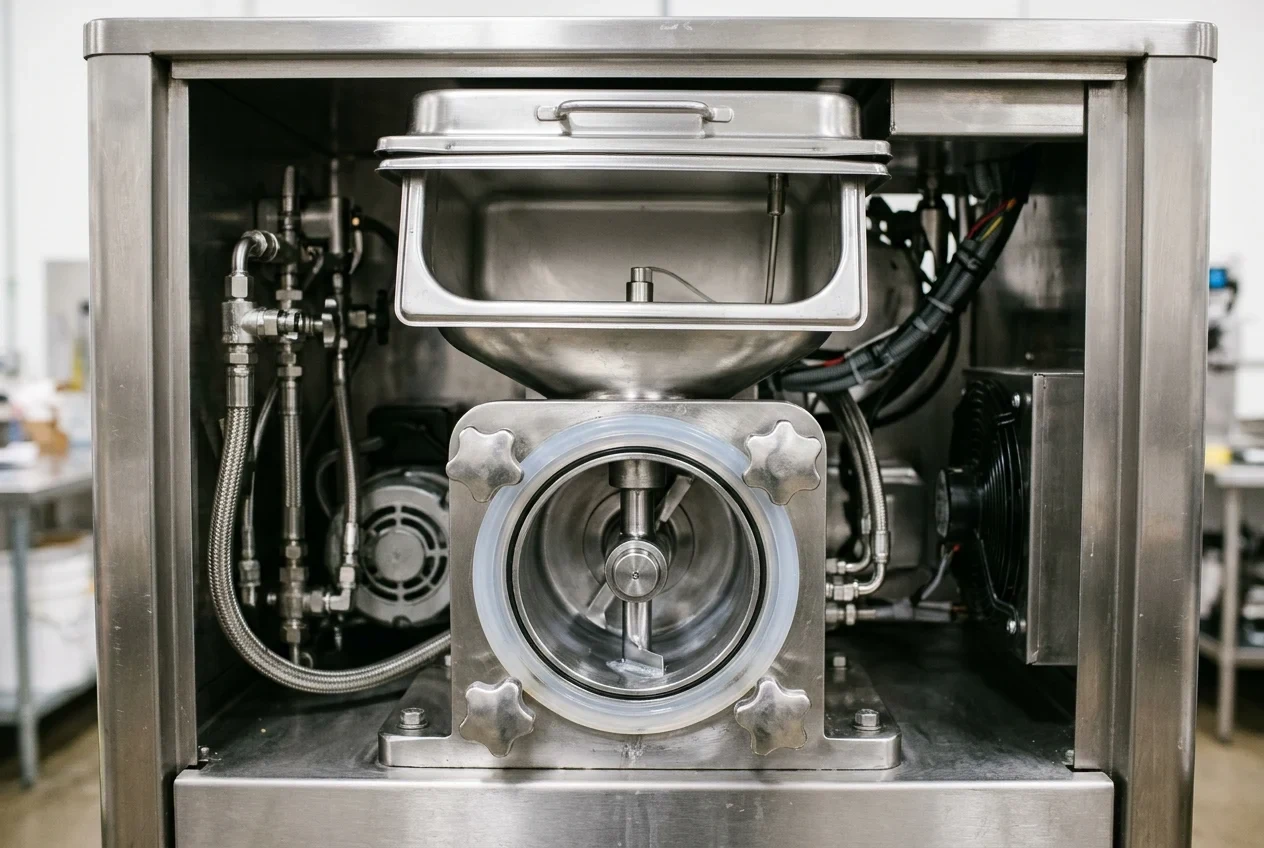
The Taylor Model C707 single-flavor soft-serve freezer has one 3.4 quart (3.2 liter) freezing cylinder and one 20 quart (18.9 liter) mix hopper, with Separate Hopper Refrigeration (SHR) that maintains mix below 41ºF (5ºC) during Auto and Standby modes.
The Taylor Model C707 soft-serve freezer uses one 9,500 BTU/hr R404A main refrigeration system and one 400 BTU/hr R134a Separate Hopper Refrigeration (SHR) system.
The Taylor Model C706 single-flavor pump freezer uses a simplified air/mix pump that delivers the precise amount of mix and air to the freezing cylinder for consistent overrun, while Separate Hopper Refrigeration (SHR) maintains mix below 41ºF (5ºC).
In the dual-cylinder floor-standing soft serve machine specification, two 3.2 Liter (3.38 quarts) freezing cylinders and two 15 Liters (15.9 quarts) mix hoppers use separate hopper refrigeration to maintain mix temperature below 4.4°C (40°F) during Cool and Standby modes.
In the dual-cylinder floor-standing soft serve machine specification, total installed power is 4 kW on 380V / 50 Hz / 3 phase electrics, using R404A (900g x 2) for the main compressor refrigerant and R134A (100g) for the sub-compressor refrigerant.
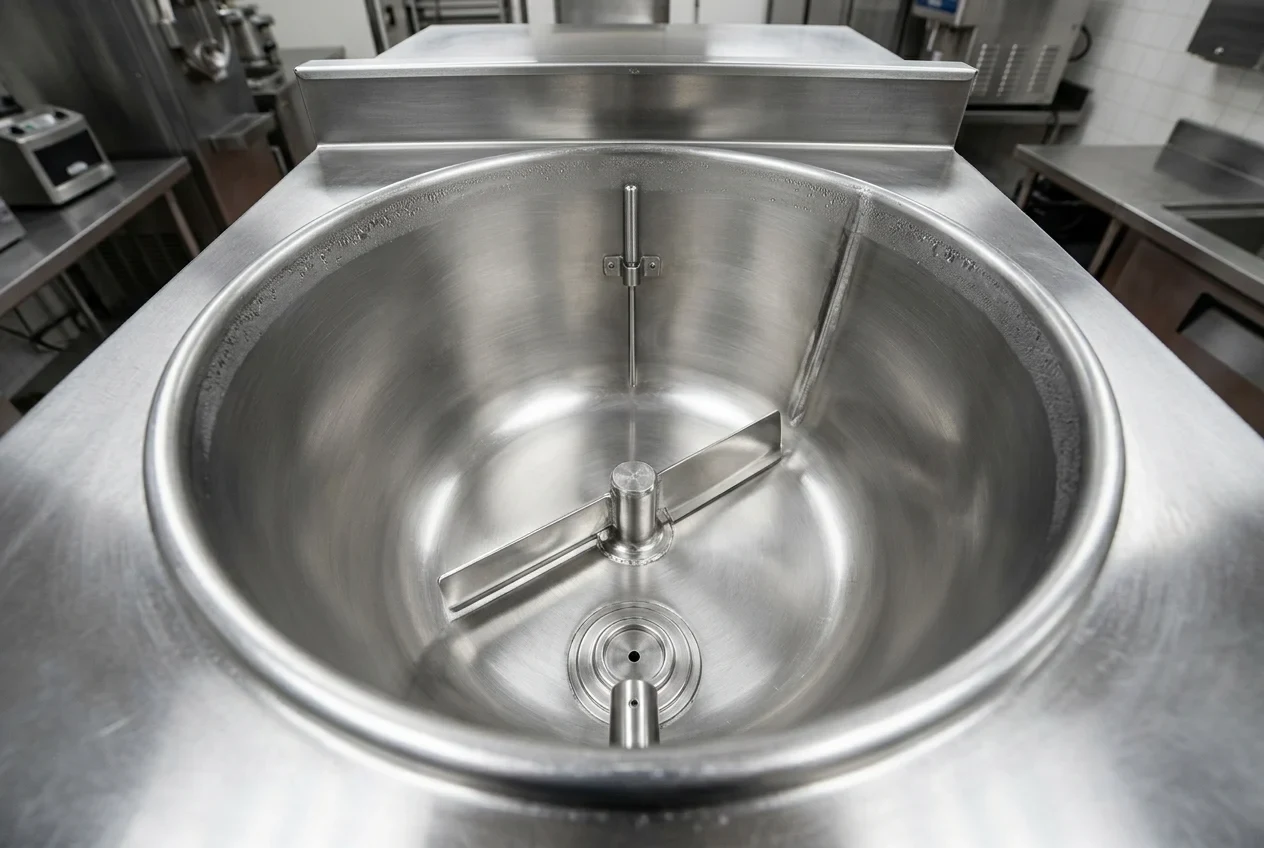
Check ice cream vending power and condenser clearance — Review electrical circuit sizing and condenser airflow rules for main barrel and hopper refrigeration compressors.
Compare robotic cone and cup dispensing mechanisms — Inspect cup turrets, cone baffles and optical sensors positioned below the freezer draw valve.
Daily dispense spout brushing, periodic teardown and public health sanitation steps
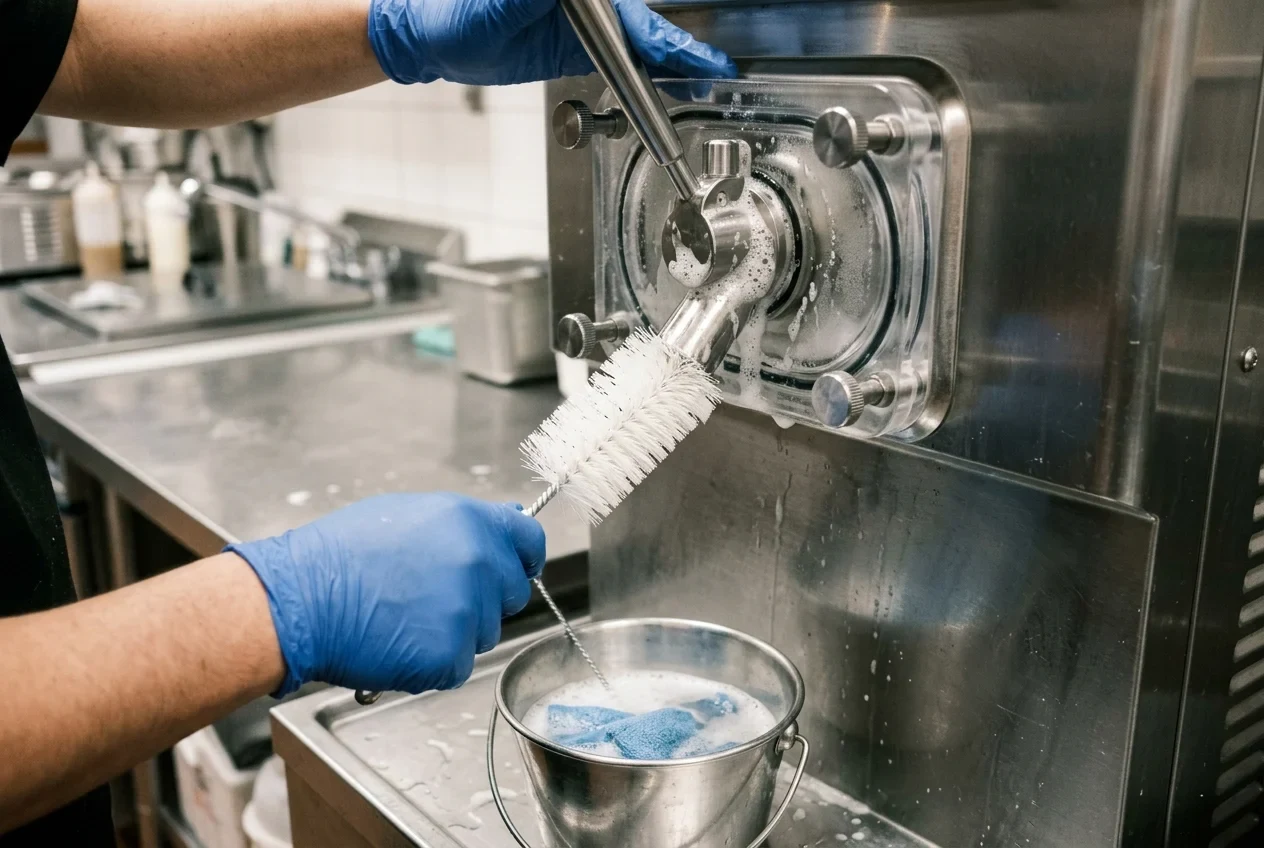
In daily opening procedures after a Heat cycle on Taylor Models C708 and C716, operators prepare a small amount of an approved 100 PPM sanitizing solution (Kay-5 or Stera-Sheen) to brush-clean the door spout(s) and bottom of the draw valve(s).
In daily opening procedures on Taylor Models C708 and C716, to ensure sanitary conditions are maintained when cleaning the door spout and draw valve bottom, operators brush-clean each item for 60 seconds, repeatedly dipping the brush in sanitizing solution.
For manual hopper cleaning during brush-clean teardown on Taylor Models C708 and C716, operators prepare an approved 100 PPM cleaning solution such as 2-1/2 gal. (9.5 L) of Kay-5 or 2 gal. (7.6 L) of Stera-Sheen.
In the ZM-series commercial soft-serve manual, after dissolving disinfectant in warm water in the hopper, operators press CLEAN to beat for 5minutes and drain it, and then pour in clear water to wash 3-5 minutes.
In the Jefferson County Department of Health soft-serve cleaning guide, at the end of each operational day operators drain and discard leftover mix (never reusing it) and fill the hopper halfway with warm water (under 110°F) to rinse.
In the Jefferson County Department of Health soft-serve cleaning guide, operators thoroughly wash disassembled parts using appropriate brushes, rinse in clean warm water (95°F –110°F) to air-dry overnight, and use an approved acid detergent once a week to remove milk stone deposits.
In the Jefferson County Department of Health pre-use soft-serve sanitizing guide, after filling the hopper with sanitizer (Chlorine, Lactic Acid, or Quaternary Ammonia), operators run the dasher for 2 minutes with solution in the barrel, drain thoroughly through the dispensing valve, and do not flush or rinse the sanitizing solution with water.
Federal pasteurization rules, bacterial limits and vending health code checklist
Federal dairy regulations and local environmental health codes govern pasteurization temperatures for sweetened mix, post-pasteurization bacterial counts, clean-in-place tubing circulation and hopper cover port geometry.
Under Footnote 1 to the federal mandatory pasteurization table, if the fat content of the milk product is 10 percent or more, or if it contains added sweeteners, the specified pasteurization temperature shall be increased by 5 °F (3 °C).
In the federal frozen dessert regulations, pasteurized mix has been heated in properly operated equipment to 155 °F for 30 min. or 175 °F for 25 sec.
Under the federal standard of identity, ice cream contains not less than 1.6 pounds of total solids to the gallon, weighs not less than 4.5 pounds to the gallon, and contains not less than 10 percent milkfat, nor less than 10 percent nonfat milk solids.
Under the U.S. Grade A Pasteurized Milk Ordinance (PMO), Grade A milk must have a microbial load less than 100,000 CFU/ml for raw milk and must be below 20,000 CFU/ml after pasteurization.
While the Grade A Pasteurized Milk Ordinance (PMO) has no coliform standard for raw milk, it states that the coliform count in pasteurized milk should not exceed 10 CFU/ml.
Under the Maricopa County Environmental Health Code for vending machines, CIP (cleaning-in-place) of fixed pipes or tubing requires that a detergent solution, water rinse, and sanitizing solution can be circulated throughout the fixed system to contact all interior surfaces.
Under the Maricopa County Environmental Health Code for vending machines, any port opening through a nonpressurized food or ingredient container cover shall be flanged upward at least 3/8” and provided with a cover that overlaps the flange.
Under U.S. Department of Energy commercial refrigeration definitions, a blast chiller is commercial refrigeration equipment capable of the rapid temperature pull-down of hot food products from 135 °F to 40 °F within a period of four hours.
The SelfServiceMachines.com Machine Factory Acceptance Test Checklist is filled in the order of scope, samples, the customer cycle, exceptions, handover and retest.
On SelfServiceMachines.com, submitted project brief details are used to continue the scope and configuration discussion, and we reply within 24 hours.
Open the machine factory acceptance test checklist — Verify scope, sample mix, customer dispensing cycles, lockout exceptions and handover documents in sequence.
Prepare a soft ice cream vending machine quotation request
Send SelfServiceMachines your target venue type, liquid dairy or powder mix format, preferred hopper feed architecture, cleaning workflow and local operator arrangement.
Request an itemized quotation covering the freezer barrel and hopper refrigeration system, nocturnal heat treatment capability, temperature lockout logs, dispense station sanitation access and factory acceptance test checklist before placing a deposit.
Sources
- SelfServiceMachines — Ice Cream Vending Machines Category Hub
- SelfServiceMachines — Packaged Ice Cream Versus Soft-Serve Vending
- SelfServiceMachines — Frozen Vending Temperature and Fault Checks
- SelfServiceMachines — Machine Factory Acceptance Test Checklist
- Taylor Company — Heat Treatment Soft Serve Freezer Operator and Service Manuals
- Taylor Company — Gravity and Pump Soft Serve Freezer Specification Sheets
- Machinery World — Floor-Standing and Countertop Soft Serve Machine Technical Specifications
- Commercial Soft-Serve Ice Cream Machine User Manual
- United States Government Publishing Office Electronic Code of Federal Regulations — Mandatory Pasteurization and Frozen Desserts
- United States Government Publishing Office Electronic Code of Federal Regulations — Commercial Refrigeration Equipment Definitions
- FoodSafetyTech — Pasteurized Milk and Pasteurized Milk Ordinance Bacterial Load Specifications
- Maricopa County Environmental Services Department — Environmental Health Code for Vending Machines
- Jefferson County Department of Health — Cleaning and Sanitizing Soft Serve Ice Cream and Frozen Yogurt Machines