

A NEW CHAPTER IN READING REWARDS
Book Vending Machines for Schools
First separate paid book sales from reward collection, then check dispensing and school permissions with the actual assortment. Assuming lending, points integration or total capacity as default capability can lead to a wrong procurement scope.
For schools, education distributors and reading-programme operators.
Share your machine configuration and operating requirements with our team.
Explore the details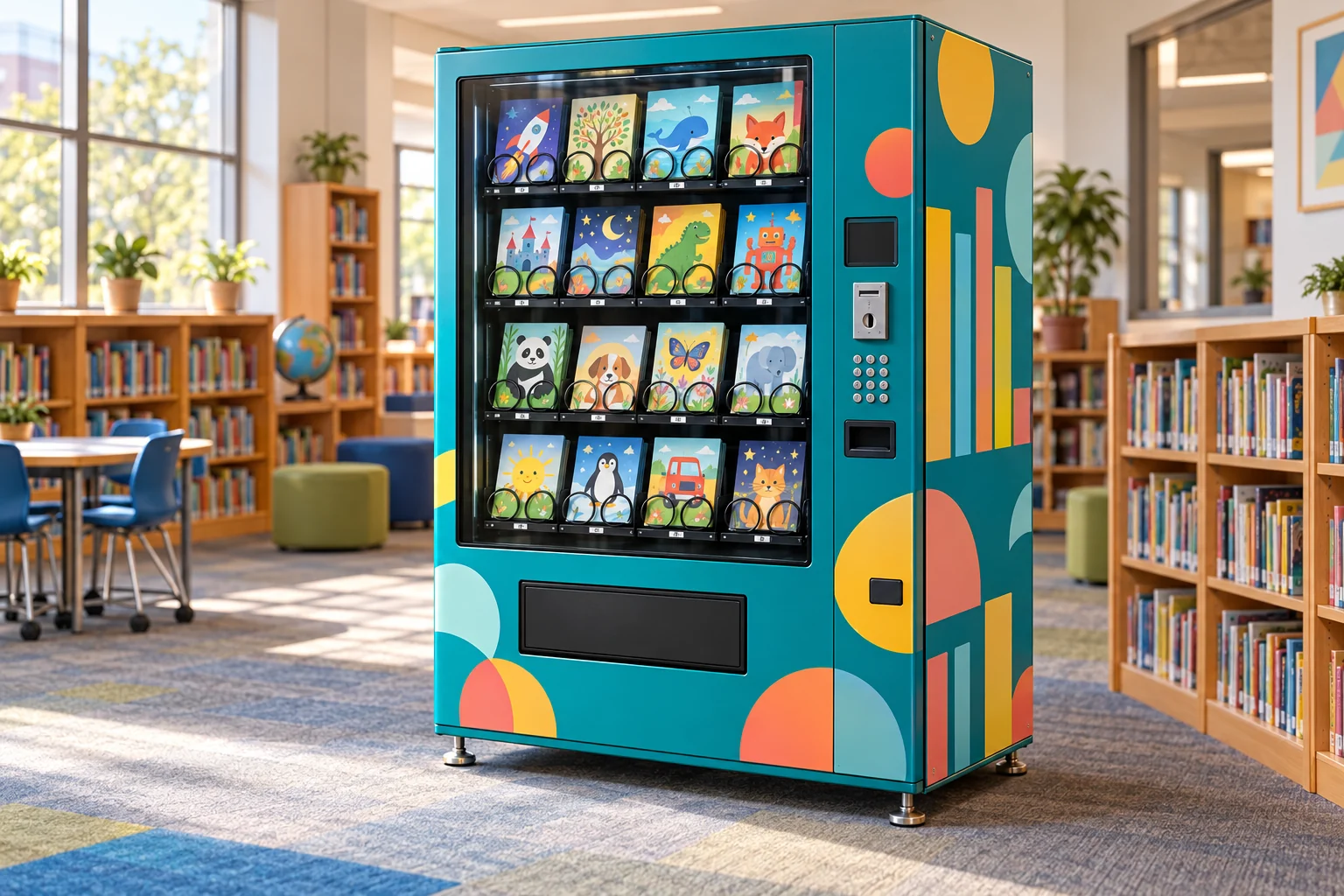
- Reward or paid workflow
- Book-size matching
- School-led selection
FROM IDEA TO CONFIGURATION
Make choosing a book part of the reward.
- Define how readers earn access
- Let the book list guide the trays
- Plan replenishment and programme ownership
POSSIBLE SETTINGS
School libraries
Reading programmes
Community-sponsored book projects
01
Paid Book Sales or Reading Rewards
Decide who receives access, how it is earned and who selects books. Identify the programme administrator. If both modes are proposed, request their complete workflows separately. This scope concerns dispensing books; lending, returns, borrowing accounts and lending-inventory reconciliation remain separate.
Book Vending: Rewards vs Paid Sales — Use this when both modes are proposed: compare permissions, exceptions and staff tasks, and verify mode switching separately.
Project review sequence
02
Book Size, Capacity & Dispensing Tests
List representative books with height, width, thickness and cover type, including rigid and less rigid examples. Use physical samples with the proposed mechanism and loading arrangement. Retain books, settings, outcomes and failed-vend handling in the test record; request position and service-access drawings.
Book Vending Machine Size Compatibility — Use this to measure complete book samples, then observe loading, release, collection and site access before an assortment is approved.
03
Tokens, Points & Access Rules
Describe reward authorisation, redemption and staff response to lost tokens or failed selection. Request the proposed token specification and demonstration. Points integration needs separate system, permission, data-exchange and support review; no universal token format or existing points interface is verified here. Keep pupil identifiers out of initial discussions. Customer sequences to agree for the selected configuration: paid selection → payment → collection / help; reward authorisation → token or code → selection → collection / staff help.
The record below uses the Paid Book Sales, Book Size and Tokens sections on this page. It keeps the boundary that no universal points interface is verified here. The rewards-versus-paid page compares permissions, exceptions and staff tasks for each mode and says to verify mode switching separately. The size-compatibility page measures complete samples and observes loading, release, collection and site access, and that preparation record has no prefilled results. This record is a procurement preparation tool. It is not a completed test and it is not a service commitment from this site.
Two user sequences
04
School Placement & Restocking
Review the indoor location, doorways, circulation, loading and service access with school facilities staff. Obtain model-specific installation and anti-tip instructions. Use site photographs without identifiable children or records. Assign assortment choice, refilling, stock checks and failed-vend help.
Vending and Reward Equipment for Schools — Use this to review the school programme, placement and the pupil-information boundary before facilities staff agree the location.
05
Configuration & Procurement Documents
Compare configuration, artwork, transport, installation and support separately. Request sample-test records and operating instructions for the offered version. Approved artwork and permissions are needed for school marks. Define software and personal-data responsibilities. We agree the configuration, sample checks and operating handover in the project specification. Supply and fit stay with that offered configuration, using the measured book list and the sample test. School count, quantity and purchasing timeline remain buyer inputs.
06
Send Your School Book List
Send the school book list, the largest and smallest samples, and any programme or location decision still open. The related pages are for comparing paid and reward workflows, measuring book samples, and reviewing school placement.
Book Vending: Rewards vs Paid Sales — Use this to compare access rules, customer journeys, sample-book tests and the staff needed for each mode.
Book Vending Machine Size Compatibility — Use this to measure book dimensions, weight and packaging, then check loading, release, collection and cabinet access before approving an assortment.
Vending and Reward Equipment for Schools — Use this to review school placement, facilities checks and the pupil-information boundary before the location is agreed.
Frequently asked questions
Does this scope include book lending and returns?
This question comes from the dispensing boundary on this page. The scope is dispensing books. Lending, returns, borrowing accounts and lending-inventory reconciliation remain separate, so they are not included as a default capability.
Is a token specification universal?
This question comes from the token review on this page. No universal token format is verified here, and no existing points interface is verified here. Request the proposed token specification and a demonstration. Points integration needs its own system, permission, data-exchange and support review.
Can paid sales and reward collection be switched directly?
This question comes from the two-mode note on this page and from the rewards-versus-paid page. If both modes are proposed, request each complete workflow separately. That page says to review hardware, account, software and procedure changes, and to verify mode switching separately. A demonstration of one mode is not proof of the other.