

ICE VENDING BUILT AROUND THE SITE
Ice Vending Machine Project Assessment
Compare on-site ice production and bagged-ice vending requirements. Submit capacity, utilities, location and support needs for feasibility review.
For operators assessing equipment, site requirements and local support.
- Production or pre-bagged route
- Demand and storage planning
- Installed-cost review
FROM IDEA TO CONFIGURATION
Start with how the ice reaches the customer.
- Choose the ice supply route
- Size the site requirements
- Review output and maintenance evidence
POSSIBLE SETTINGS
Fuel and convenience sites
Campsites
Leisure and travel destinations
01
On-Site Ice Production or Pre-Bagged Vending
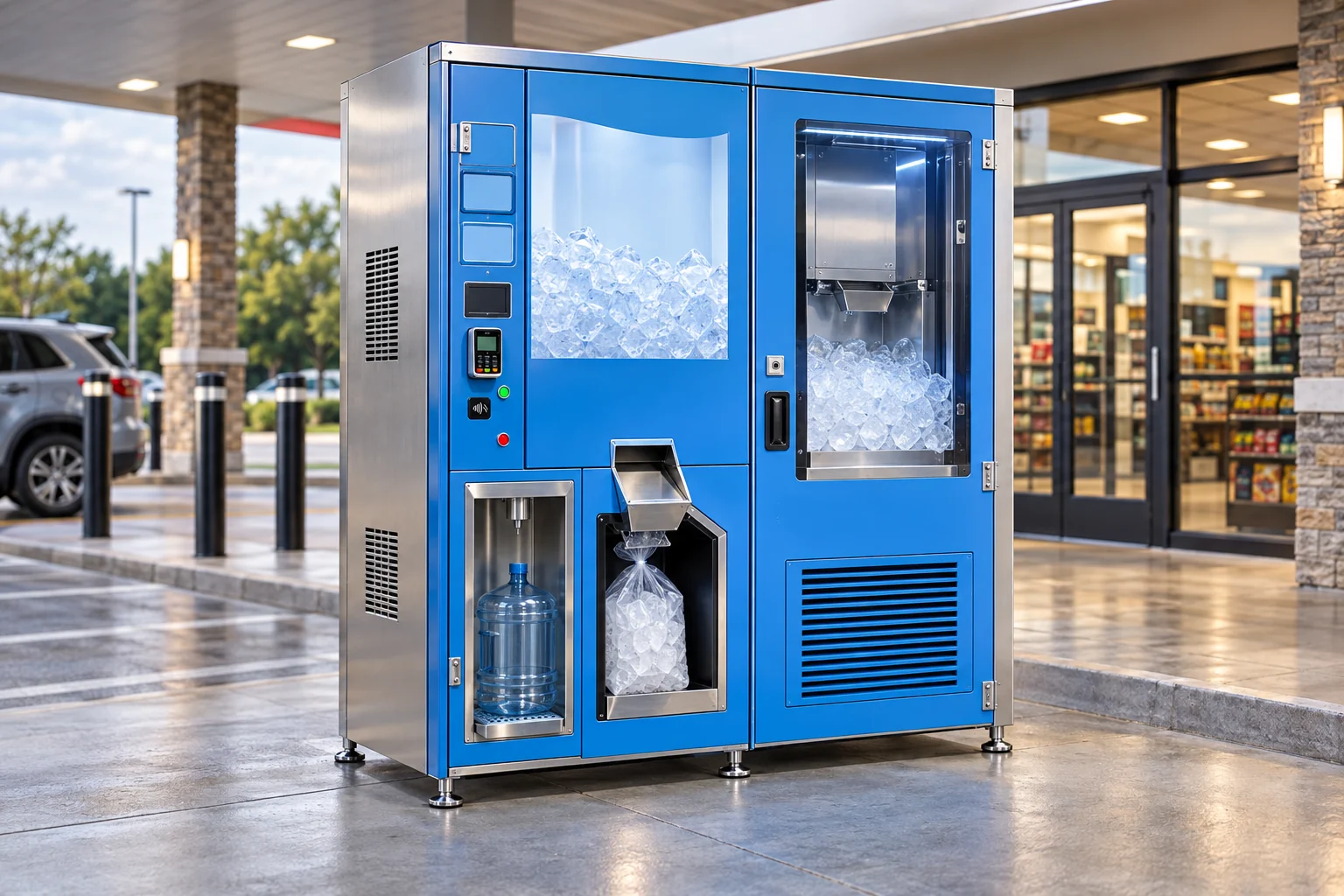
Begin by selecting the operating route. A project that produces ice at the point of sale has a different equipment and utility scope from a project that dispenses pre-bagged ice replenished by an operator. State whether the customer is expected to collect loose ice, a filled bag or a pre-packed bag.
If you also want to sell drinking water, describe that as an additional requirement. Do not assume that an ice configuration includes water treatment, a drinking-water outlet or the same payment workflow. Ask for a complete process diagram for the proposed route, including replenishment, dispensing and fault handling. This page is a project assessment; a verified equipment package has not yet been established.
For a combined water and ice vending machine, list the ice production or replenishment route and the drinking-water dispensing requirement separately in the same project brief. Ask which treatment, storage, metering, payment and service arrangements are included in the proposed combination. Record demand and operating costs for each output separately; a combined cabinet does not establish identical capacities or responsibilities for both services.
02
Output, Storage & Dispensing Conditions
State your target daily sales, expected peak periods, desired storage and the amount delivered in one transaction. Keep sales assumptions separate from the machine's tested production output. For a production-based route, request performance data that names the model and the test conditions, including incoming-water and surrounding-air conditions.
For pre-bagged vending, request the supported bag dimensions, storage arrangement and replenishment procedure. For on-site production, clarify how production, storage and dispensing interact when demand peaks or operation is interrupted. We do not use an unverified daily-output figure to size the project. Capacity selection should follow evidence and a review of the actual site conditions.
03
Water, Power, Drainage & Site Access
Provide a site drawing with the proposed equipment position, access for delivery and servicing, and the intended customer approach. Describe available water, electrical supply and drainage. Include any known restrictions affecting vehicle access, lifting, utility routing or outdoor placement.
Request the selected model's utility and installation documents before commissioning site work. The local installer must check those documents against the actual connections and installation conditions. If water treatment is proposed, identify the incoming-water information needed to assess it. Avoid assuming a standard connection size, electrical rating or foundation from another project's installation. Each unresolved utility item should have a named party responsible for verification.
04
Hygiene, Maintenance & Local Support
Ask the supplier for food-contact documentation, cleaning instructions, service access requirements and procedures for recovering after a fault or shutdown. Have the operator and appropriate local specialists review how these apply to the intended route and location. This page does not confirm regulatory acceptance for any country.
Allocate responsibility for cleaning, consumables, inspections, water-related checks and repair response. Establish how an operator will recognise a condition that requires stopping sales and whom they will contact. Request the evidence and instructions for the actual configuration rather than accepting a generic hygiene claim. Remote technical support, on-site service and spare-parts availability are separate items to verify.
05
Equipment Budget vs Installed Project Budget
Build an installed-project budget alongside the equipment quotation. Distinguish production equipment, storage, dispensing, any proposed treatment or bagging equipment, payment hardware and software. Then list packaging, freight, import handling, site work, utilities, installation and commissioning separately.
Record which party supplies each item and which costs remain estimates. Operating assumptions should separately identify consumables, utilities, maintenance and payment-service charges. We do not publish a fixed delivered price or a return-on-investment promise without a defined project and supporting figures. A formal quotation should specify its route, configuration, currency, trade terms, exclusions and validity period.
06
Submit an Ice Vending Feasibility Brief
Contact us on WhatsApp with the destination country and city, site type, operating route and purchasing timeline. Describe intended daily demand and transaction size, distinguishing targets from measured sales. Include the known utility conditions, site-access constraints and the local installation or maintenance arrangements.
If no location has been secured, say so and identify the selection criteria you are working with. Unknown capacity or utility answers should remain open questions. The assessment should result in a list of missing evidence, a feasible route to investigate and the next responsible parties. A sourcing discussion can advance to a formal sales proposal only after the relevant configuration and supply checks have been completed.
LET’S REVIEW YOUR PROJECT
Build your project brief
Describe the operating route, expected demand, site utilities, destination and local support arrangements.